Jaipur - Mandawa - Bikaner - Jaisalmer - Jodhpur - Udaipur
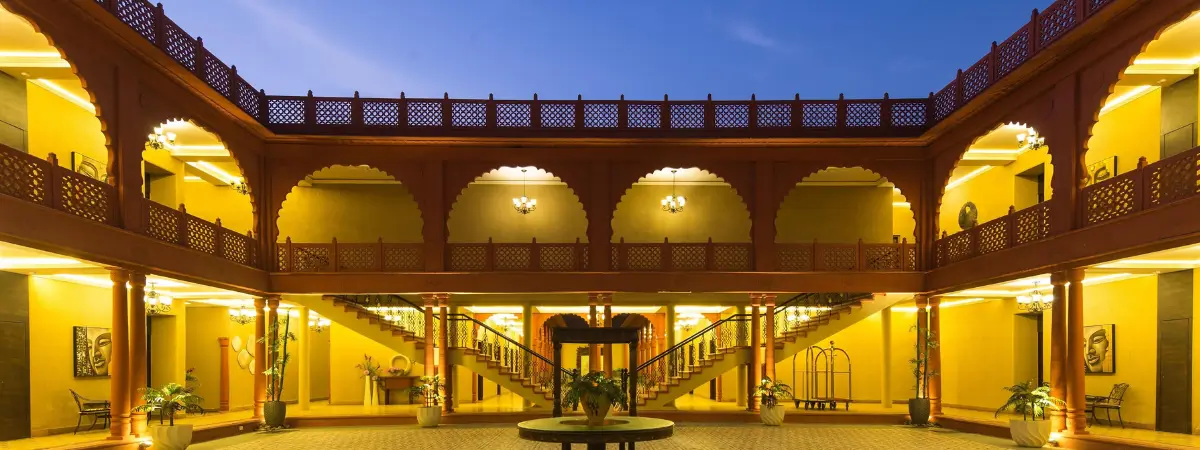
Most Rajasthan itineraries let you admire palaces from the ticket queue; on this one you go to sleep inside them. The Royal Rajasthan Private Tour with Palace Stays runs for eighteen days in a wide loop from Jaipur through the painted towns of Shekhawati, the camel country around Bikaner, the golden sandstone of Jaisalmer, the blue lanes of Jodhpur and finally the lakes of Udaipur. Every night is spent in a heritage property that was once a royal residence, a noble's fort or a merchant's haveli, and in several of them the owning family still lives in one wing. You will eat dinner in old durbar halls, wake to peacocks on castle ramparts and hear stories about the building straight from the people whose grandparents built it.
The route is designed as a classic Rajasthan road trip by private car and driver, with one chauffeur for the whole tour and drives kept to a sensible length, usually three to five hours with stops for tea, photographs and village life. Because the Thar Desert section is remote, we have built in two- and three-night stays so that no day feels rushed. Local guides join you in each major city, and in the smaller places your chauffeur or the hotel's own heritage walk takes over. Magan Singh, who founded our company in Jaipur, chose these properties personally for their character and service rather than star ratings. Expect thick stone walls, carved balconies and antique furniture alongside modern bathrooms, reliable Wi-Fi and swimming pools at most stops on this Rajasthan palace hotel tour.
Tour Highlights
 Package Includes:
 Package Excludes:
Reply within 24hrs
Welcome to the pink city. Whether you land at Jaipur International Airport on a connecting flight from Delhi or Mumbai, or arrive by train at Jaipur Junction, our representative and your chauffeur will be waiting with a name board and a garland of marigolds. Your chauffeur, who will stay with you for the full eighteen days, introduces himself, loads the luggage and drives you about twenty-five minutes to your palace hotel. Our usual choice is a former royal guest house or a nobleman's residence such as Narain Niwas Palace or Samode Haveli, both of which have shaded courtyards, frescoed corridors and a calm pool set back from the noise of the city.
After you check in and settle, take a slow walk around the gardens, where peacocks are often heard before they are seen. Your tour manager will meet you for a cup of masala chai to go over the route, explain how heritage hotels differ from modern chains, and talk you through local customs such as removing shoes at temples and covering shoulders at some shrines. In the evening, dine in the hotel's mirrored dining hall on a gentle introduction to Rajasthani cooking, including ker sangri made from desert beans and berries, followed by a bowl of ghewar for dessert.
Overnight stay in Jaipur.
The day begins with a drive about 11 km north of the city, passing the Jal Mahal water palace on the way, to Amber Fort, the honey-coloured hill fortress that was the Kachwaha capital before Jaipur was built. Your guide takes you up through the Ganesh Pol, a richly painted gateway that leads into the private quarters of the Maharaja, and explains the clever design of the Sheesh Mahal, where a single candle could light the whole mirrored chamber. Behind Amber, the older Jaigarh Fort holds Jaivana, said to be the largest cannon on wheels ever cast; a short drive along the ridge connects the two forts.
In the afternoon, your Jaipur sightseeing tour continues in the old city. Visit the City Palace, where the current royal family still lives in the seven-storey Chandra Mahal, and the flag on top tells you whether the Maharaja is in residence. Next door, the stone instruments of Jantar Mantar still tell the time accurately. Stop for a photograph at Hawa Mahal and then walk through Johari Bazaar for jewellery and Bapu Bazaar for printed textiles and leather slippers called mojari. End the day with a cup of lassi at Lassiwala on MI Road, a Jaipur institution.
Overnight stay in Jaipur.
A gentler pace this morning. Your guide takes you to Royal Gaitor, the cremation ground of the Jaipur rulers at the foot of Nahargarh hill, where carved marble cenotaphs stand in a quiet walled garden that most visitors miss. Then continue to the Albert Hall Museum, housed in a fine Indo-Saracenic building in Ram Niwas Garden, where the collection includes miniature paintings, costumes, carpets and an Egyptian mummy. Lunch is at a garden restaurant in the Civil Lines neighbourhood, close to the bungalows where the old British residents once lived, and the afternoon is free to relax at your hotel pool.
In the late afternoon we arrange a home cooking session with a local family in their haveli in the old city. You help prepare three or four dishes, perhaps dal, a seasonal vegetable, chapatis rolled by hand and a sweet rice kheer, then sit down to eat together on the terrace as the sun sets over the rooftops. It is a relaxed way to see family life in Jaipur and to ask the questions you might not ask a guide. Your chauffeur collects you afterwards for the drive back to the hotel. Recipes are written down for you to take home.
Overnight stay in Jaipur.
After breakfast, leave Jaipur and drive north-west into Shekhawati, a semi-desert region once home to wealthy Marwari merchant families who made their fortunes in Calcutta and Bombay and spent them on decorating their ancestral homes. The road passes through mustard fields, khejri trees and small market towns. Along the way, stop at Samode village, if time allows, or at a roadside dhaba for chai and a plate of hot kachori. Your chauffeur aims to reach Mandawa in time for lunch at your heritage castle hotel, where the welcome includes a traditional tilak on the forehead. Mandawa is a small town, so the pace slows noticeably from here.
Our usual choice here is Castle Mandawa, an eighteenth-century fort still owned by the descendants of the Thakur who built it. Rooms are arranged around courtyards and towers, and no two are alike. In the late afternoon, your local guide takes you on a walk through the lanes of the town to see havelis covered in frescoes painted in the eighteenth and nineteenth centuries: gods, battle scenes, trains, motorcars and even aeroplanes, painted by artists who had never seen one. Return to the castle for a rooftop dinner with folk music. Look out for the painted Ganesh above many doorways, placed there to bless the household.
Overnight stay in Mandawa.
Today covers the wider Shekhawati region, known as the open-air art gallery of Rajasthan. Drive about 30 km to Nawalgarh, where the Poddar Haveli Museum has been beautifully restored and gives a clear sense of how a merchant family lived, with displays of costumes, musical instruments and wedding customs. Nearby, the Morarka Haveli has some of the best-preserved original frescoes in the region, protected for decades behind closed doors. Your guide explains the natural pigments used in the paintings and the stories behind the many images of Krishna and the Ramayana. Bring a small torch to see the painted ceilings inside darker rooms.
After lunch, continue to Fatehpur, where the Haveli Nadine Le Prince was restored by a French artist and now hosts a cultural centre, and to the smaller town of Dundlod with its little fort and the Goenka havelis. Shekhawati has very few tourists, so expect curious children, friendly shopkeepers and plenty of chances to photograph doorways and painted walls without crowds. Return to Mandawa late in the afternoon for a camel cart ride through the surrounding fields at sunset, a pleasant way to see farming life outside the town. The cart driver often stops at a farmhouse where tea is brewed on a cow-dung fire.
Overnight stay in Mandawa.
Leave Mandawa after breakfast and drive west towards Bikaner, crossing into the true Thar Desert, where the villages are smaller and the dunes start to appear at the roadside. Around 30 km before Bikaner, stop at Deshnoke to visit the Karni Mata temple, famous for the thousands of rats that live in the temple and are considered holy. Seeing a rare white rat is believed to bring good luck. The silver doors and marble carvings at the entrance were a gift from Maharaja Ganga Singh of Bikaner, and shoes must be removed, so bring socks if you are squeamish. The temple opens early and the visit takes under an hour.
Arrive in Bikaner and check in at the Laxmi Niwas Palace or a similar heritage property, a red sandstone palace built for Maharaja Ganga Singh in the early twentieth century. The carved facades, hunting trophies and grand billiard room give a strong sense of royal life in the last days of the princely states. In the evening wander through the palace grounds, where the Lalgarh Palace and the Sadul Singh Museum share the same estate, and dine in the old banquet hall under chandeliers and paintings of former rulers. Ask the staff about the old royal railway saloon displayed on the grounds.
Overnight stay in Bikaner.
Begin with Junagarh Fort, one of the few major forts in Rajasthan not built on a hill, and one that was never conquered. Your guide leads you through a succession of palaces built over several centuries: the Anup Mahal with its gold-leaf ceiling and lacquer work, the Phool Mahal decorated with mirror and floral painting, and the Badal Mahal, painted with blue clouds and rain to remind rulers of the monsoon in this dry land. The museum also displays a First World War biplane gifted to Maharaja Ganga Singh. Afterwards walk through the old city to see the merchant havelis of the Rampuria family, built in red sandstone with fine carving.
After lunch, try the famous Bikaneri bhujia, a crunchy gram-flour snack, at one of the old shops near Kote Gate. Later in the afternoon visit the National Research Centre on Camel, about 8 km outside the city, where you can see hundreds of camels returning from grazing, learn about the different breeds and taste camel milk ice cream or coffee. The visit gives a good sense of how important the camel still is to desert life. Return to the palace for an evening at leisure. The centre is usually open in the afternoon only, which suits the timing well.
Overnight stay in Bikaner.
This is the longest drive of the tour, so we start early with a packed breakfast if you prefer. The road crosses the heart of the Thar Desert, passing through Kolayat, with its lake and temple ghats, and Pokaran, where a small yellow sandstone fort stands near the town centre. Your chauffeur knows the best stops along the way for tea and lunch, and you will see herds of goats and camels, women in bright skirts carrying water and the occasional chinkara gazelle near the road. The landscape is flat and open, with distant views and a huge sky. Pokaran also has a small fort museum worth a brief look.
Arrive in Jaisalmer in the afternoon and check in at your heritage hotel, built from the same golden sandstone as the fort. Our usual choice is a restored royal guesthouse in the old city or a palace-style hotel on the outskirts with views of the fort walls. In the evening, walk up to Vyas Chhatri, a cluster of sandstone cenotaphs on a small hill west of the city, for sunset. As the light fades, the fort turns from gold to amber to deep red, and the walls glow against the darkening sky. Carry water, as the climb is short but the stone holds heat even late in the day.
Overnight stay in Jaisalmer.
Spend the morning inside Sonar Qila, the golden fort, one of the few living forts in the world, where about a quarter of Jaisalmer's population still lives inside the walls. Your guide leads you through the four massive gates to the Raj Mahal, the royal palace, then on to a group of Jain temples dating from the twelfth to the fifteenth centuries, carved in yellow sandstone with incredible detail. Walk through the narrow lanes inside the fort, past houses, shops and small cafes, and stop at the ramparts for views over the rooftops of the city below. Shoes must be removed at the temples, and leather is not allowed inside.
After lunch, visit the havelis of the old city. The Patwon ki Haveli is a cluster of five houses built by a wealthy Jain merchant family, with sandstone balconies so finely carved they look like lace. The Nathmal ki Haveli was carved by two brothers, one working on each side, and the two halves are similar but not identical. End the afternoon at Gadisar Lake, a man-made reservoir surrounded by small temples and shrines, where you can take a short rowing boat ride or feed the catfish. Evenings here are calm, with families strolling the waterfront and snack sellers offering pyaz kachori.
Overnight stay in Jaisalmer.
In the morning drive about 18 km west to Kuldhara, a village abandoned by the Paliwal Brahmins in the early nineteenth century. According to local legend, the whole community left in a single night to escape a tyrannical minister and placed a curse on the village so that no one could live there again. The stone houses, lanes and temple are well preserved and easy to walk around. On the way back, stop at Bada Bagh, a garden of royal cenotaphs on a ridge north of the city, set among wind turbines and dry hills. Morning light is softer for photographs.
After lunch, drive about 42 km west to the Sam sand dunes, the most famous desert area near Jaisalmer. A camel ride takes you into the dunes for sunset, and the guides often sing as they walk. When the sun has gone down, return to a desert camp for a performance of Kalbeliya folk dance and music by Manganiyar singers, followed by a Rajasthani dinner by the campfire. Late in the evening, your chauffeur drives you back to your hotel in Jaisalmer, or if you prefer, we can arrange an extra night in a luxury desert tent.
Overnight stay in Jaisalmer.
After a leisurely breakfast, leave Jaisalmer and drive east to Jodhpur, the second-largest city in Rajasthan. The road passes through Pokaran and Balesar, crossing open desert dotted with small villages, khejri trees and grazing herds. A lunch stop in a roadside hotel or dhaba gives you a chance to try mirchi vada, a large green chilli stuffed with spiced potato and fried in batter, which is a Jodhpur speciality. The approach to the city is dramatic, with Mehrangarh Fort rising high above the plain on a rocky hill. Expect a few army convoys on this stretch, as the region is close to the border, and your chauffeur will pass them patiently.
Check in at your palace hotel. Our usual choice in Jodhpur is Ajit Bhawan, built for a younger brother of the Maharaja and still run by the royal family, or a heritage property in the shadow of the fort. Spend the evening relaxing by the pool or walk to the Ghanta Ghar, the clock tower in the middle of Sardar Market, where stalls sell spices, textiles, silver and vegetables. The famous omelette shop near the clock tower has been feeding visitors for decades and is worth a stop. Dinner can be at the hotel or at a nearby garden restaurant.
Overnight stay in Jodhpur.
Begin with Mehrangarh Fort, one of the largest forts in India, rising about 125 metres above the city on a sheer cliff. The audio guide is excellent, but your local guide adds the stories that make the fort come alive. Walk up past the Jai Pol and Loha Pol gates, where the handprints of royal widows who committed sati are still visible on the wall. Inside, the Phool Mahal, Sheesh Mahal and Moti Mahal are decorated with gold, mirrors and stained glass, and the museum holds a fine collection of palanquins, howdahs, arms and miniature paintings. Allow at least three hours to see it properly.
Afterwards, visit Jaswant Thada, a white marble cenotaph built for Maharaja Jaswant Singh II, with a small lake and gardens and a view back to the fort. Then walk down through the Brahmpuri neighbourhood, where many houses are painted blue, which gives Jodhpur its nickname of the Blue City. Your guide explains the possible reasons, from caste tradition to keeping houses cool and keeping termites away. In the late afternoon visit Umaid Bhawan Palace, one of the largest private homes in the world, where part of the building is a museum. The royal family still lives in one wing of the palace.
Overnight stay in Jodhpur.
In the morning go on a jeep safari to the Bishnoi villages south of Jodhpur. The Bishnoi community follows a strict set of rules about protecting trees and wildlife, and you are likely to see blackbuck antelope and chinkara grazing near the villages. Visit a Bishnoi home to learn about the community's way of life and share a cup of tea brewed on a clay stove, the customary welcome offered to guests in these homes. Then visit a potter's workshop and a dhurrie weaver who makes cotton rugs on a pit loom. These families have made such crafts for generations and enjoy explaining their methods to visitors.
After lunch, drive about 65 km north to Osian, an ancient town on the old caravan route, with a group of Hindu and Jain temples dating from the eighth to the twelfth centuries. The Sachiya Mata temple sits on a small hill above the town, and the Mahavira temple is one of the oldest Jain temples in western India. The carvings are fine and the atmosphere is quiet. Return to Jodhpur in the evening for dinner at a rooftop restaurant with views of the floodlit Mehrangarh Fort. Dal baati and mawa kachori are good choices to try before bed.
Overnight stay in Jodhpur.
Leave Jodhpur after breakfast and drive south through the Aravalli hills to Ranakpur, about 160 km away, to visit the great Jain temple dedicated to Adinath. Built in the fifteenth century in white marble, it has 1,444 pillars, each carved differently, and the light falling through the open domes changes throughout the day. The temple opens to non-Jain visitors from around noon, so we time the drive to arrive at the right time. Leather items such as belts and wallets are not allowed inside. Have lunch at a hotel near the temple before continuing. Shoulders and knees should be covered.
The afternoon drive to Udaipur winds through green hills and small villages, a welcome change from the desert. Arrive in Udaipur in the late afternoon and check in at your palace hotel. Our usual choice is the Shiv Niwas or Fateh Prakash palace, both part of the City Palace complex and run by the Mewar royal family, or a heritage property on the shores of Lake Pichola. Spend the evening watching the sunset over the lake from your hotel terrace or a nearby rooftop restaurant. From here you can see the domes of the City Palace reflected in the water as the lights come on along the ghats.
Overnight stay in Udaipur.
After breakfast, begin your Udaipur sightseeing tour at the City Palace, which looks out over Lake Pichola from its hilltop position. Your guide leads you through the Mor Chowk, the peacock courtyard decorated with glass mosaic peacocks, the Zenana Mahal where royal women lived, and the Badi Mahal, a garden courtyard built on top of a natural rock. Walk on to the Jagdish Temple, a seventeenth-century Vishnu temple with stone elephants guarding the steps, and the old city lanes below, where artists sell miniature paintings and shops sell silver jewellery. Your guide can suggest reliable workshops. Take your time here, as the palace rewards slow wandering.
In the late afternoon take a boat ride on Lake Pichola, passing the Lake Palace and stopping at the Jag Mandir island palace. Later, in the evening, attend the Dharohar folk dance show at Bagore ki Haveli, near Gangaur Ghat. The performance includes Rajasthani music, puppetry and the famous bhavai dance, in which a woman balances a tower of brass pots on her head while dancing on the edge of a plate. Afterwards, dine at a lakeside restaurant with views of the illuminated City Palace. Seating is first come, first served, so arrive about half an hour early to secure a good spot.
Overnight stay in Udaipur.
Today's excursion takes you north of Udaipur to Kumbhalgarh Fort, a fifteenth-century fortress built by Rana Kumbha high in the Aravalli hills. The walls stretch for about 36 km around the hilltop, said to be the second-longest continuous wall in the world after the Great Wall of China. Inside are more than 300 temples, both Hindu and Jain. Climb up to the Badal Mahal, the palace of the clouds, at the top of the fort for wide views across the hills towards the Thar Desert, and hear the story of Maharana Pratap, who was born here. Wear comfortable shoes, as the walk up is steady.
On the way back, stop at a village to see farming life in the Aravallis, or at a small shrine where local people offer flowers and incense. Return to Udaipur in the late afternoon and spend the evening at leisure. You might walk around Fateh Sagar Lake, popular with local families in the evening, where vendors sell roasted corn and coconut water, or visit Saheliyon ki Bari, the garden of the maids of honour. Dinner is at your palace hotel, perhaps in a courtyard with lanterns and live music. Dress codes are relaxed here. Your chauffeur will suggest the quietest stretch of the lakeshore.
Overnight stay in Udaipur.
Spend your last full day on a trip east to Chittorgarh, the largest fort in India and the old capital of Mewar. The fort sits on a long plateau above the plains and has been besieged three times in its history. Your guide tells the stories of Rani Padmini, Rana Kumbha and Meerabai, the poet-saint who worshipped Krishna here. See the Vijay Stambh, the nine-storey tower of victory covered in carved figures, the Kirti Stambh, the tower of fame dedicated to a Jain tirthankara, and the ruins of Rana Kumbha's palace. Allow about three hours to walk the plateau. Carry water and a hat for the open plateau.
Return to Udaipur in the afternoon for a last chance to shop in the old city or relax at your hotel. In the evening, enjoy a farewell dinner arranged by our team at a rooftop restaurant overlooking Lake Pichola, with traditional Mewari dishes such as dal baati, gatte ki sabzi and lal maas. Magan Singh or a member of our Jaipur team will call to say goodbye and hear your thoughts on the tour, and your chauffeur will confirm the timing for tomorrow's airport transfer. Leave any final questions about luggage or flights with the team that evening.
Overnight stay in Udaipur.
After breakfast and time to pack, check out from your palace hotel and say goodbye to the staff who have looked after you. Depending on your flight time, there may be a chance for one last walk along the ghats of Lake Pichola or a coffee at a lakeside cafe before you leave. If your flight leaves later in the day, we can arrange a late check-out or a short visit to the Vintage Car Museum, where the Maharana's collection of classic Rolls-Royces and Cadillacs is still kept in good working order. The museum is a short drive from the lake and takes under an hour to see.
Your chauffeur, who has driven you more than 1,800 km across Rajasthan, drives you about 22 km to Maharana Pratap Airport at Dabok for your onward flight to Delhi or Mumbai and your connection home. Our representative will help with your luggage at the terminal entrance. We hope the castles of Shekhawati, the sandstone of Jaisalmer, the blue lanes of Jodhpur and the lakes of Udaipur will stay with you for a long time, and we would be delighted to welcome you back to India for another tour. Thank you for travelling with us. Until next time, from all of us in Jaipur, goodbye and safe travels.
Hear what our happy guests say about their India adventures! From private drivers to guided tours, we make every journey smooth, safe & unforgettable.
 rating score: 5.0 of 5, based on 448 reviews

Complete our inquiry form

Customize your itinerary

Confirm when you're satisfied
1-to-1 Service | Reply within 24hrs | Expert's Advice