Delhi - Jaipur - Bundi - Shahpura - Bhainsrorgarh - Deogarh - Jojawar - Udaipur
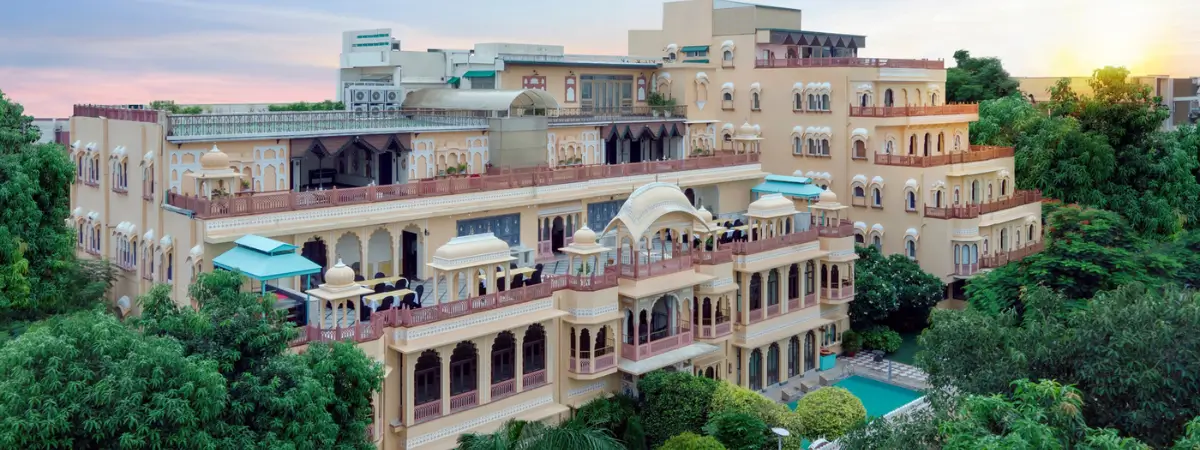
Rajasthan has a quieter side that most first-time itineraries rush past, and the Offbeat Rajasthan Tour with Boutique Heritage Stays is built entirely around it. After a measured start in Delhi and Jaipur, the road turns south into Hadoti country, where Bundi's painted palace walls and deep stepwells see a fraction of the visitors who crowd Amber. From there you move between family-run properties rather than chain hotels: a garden retreat at Shahpura, a clifftop fort above the Chambal at Bhainsrorgarh, a seventeenth-century palace in Deogarh and a rural manor house at Jojawar in the Aravalli hills. Each one is owned, and often still lived in, by descendants of the families who built it, so dinner conversation tends to drift towards local history, horses, monsoon crops and the old rivalries between Mewar and Marwar.
Two or three nights in most places keep the pace sensible, and the longer drives are broken with worthwhile stops such as the Menal temples, the Baroli temple group and the great fort of Chittorgarh. Travelling by private car and driver means you can pull over for roadside chai, a village pottery yard or a photograph of a stepwell without anyone checking a watch. Local English-speaking guides join you in the larger towns, while at the rural estates the host family usually arranges walks, jeep drives or a boat outing themselves. The trip ends in Udaipur, with time for Lake Pichola and the little-visited royal cenotaphs at Ahar, followed by a short flight to Delhi for your international connection. It suits travellers who have already seen the Golden Triangle, or who simply prefer character over crowds.
Tour Highlights
 Package Includes:
 Package Excludes:
Reply within 24hrs
Your Offbeat Rajasthan Tour begins the moment you clear immigration at Indira Gandhi International Airport, where a representative of Heritage India Private Tours waits in the arrivals hall holding a placard with your name. After a quick welcome and a few words about the days ahead, you are taken by private air-conditioned car to your hotel, usually a drive of forty minutes to an hour depending on traffic and the terminal you land at. International flights often arrive late at night, so we keep this day deliberately free. Check-in is arranged in advance, and our team shares emergency numbers and your chauffeur's mobile number on WhatsApp before you rest.
If you land in daylight and feel fresh, Lodhi Garden is a gentle first outing. The park sits a short drive from most central hotels and is full of local families, joggers and fifteenth-century tombs of the Sayyid and Lodi rulers, including the domed tomb of Mohammed Shah and the arched Bara Gumbad. A slow loop takes about an hour and is an easy way to shake off a long-haul flight without stepping into heavy crowds. For dinner, Khan Market nearby has small cafés and North Indian restaurants serving dal makhani, tandoori roti and paneer tikka. Your chauffeur will confirm the timing for tomorrow's sightseeing before you turn in.
Overnight stay in Delhi.
Today's Delhi city tour avoids the usual rush and starts in the south, in Mehrauli, one of the oldest continuously inhabited parts of the capital. With your local guide you walk through Mehrauli Archaeological Park, a wooded stretch scattered with ruins that most visitors never see: the red sandstone mosque and small painted tomb of Jamali Kamali, the stepped well of Rajon ki Baoli and the tomb of Sultan Balban, said to contain one of the earliest true arches in India. Just next door stands the Qutub Minar, the 73-metre fluted tower begun in the late twelfth century, with the rust-free Iron Pillar standing in the courtyard of the Quwwat-ul-Islam mosque at its foot.
After lunch the car heads to Humayun's Tomb, the Mughal garden tomb completed in 1570 that later influenced the layout of the Taj Mahal. Spend time in its four-part garden, then cross to Sunder Nursery next door, a restored sixteenth-century park with Mughal pavilions, a bonsai house and lily ponds that look lovely in the late afternoon light. On the way back, a short stop at Agrasen ki Baoli near Connaught Place shows a three-level stepwell tucked between office blocks, a good prelude to the far larger stepwells waiting in Bundi. Humayun's Tomb and the Qutub Minar are open every day of the week, so this day works on any date.
Overnight stay in Delhi.
After breakfast your chauffeur loads the bags and takes National Highway 48 south-west towards Jaipur. Traffic leaving Gurugram can be slow in the morning, so a start around eight o'clock usually pays off. The road is a divided highway for most of its length, and there are clean roadside restaurants near Behror and Shahpura (a different town from the Shahpura you visit later on this tour) for a tea break and a quick lunch. Expect the drive to take between five and six hours with stops. As the Aravalli ridges rise near Kotputli and the first forts appear on the hilltops, the landscape tells you that you have crossed into Rajasthan.
Jaipur nights on this tour are spent in a converted haveli or small palace hotel within easy reach of the old walled city. After check-in and a rest, take an evening drive to the Albert Hall Museum, the Indo-Saracenic building in Ram Niwas Garden that glows under floodlights after dark; the exterior alone makes a fine photograph from the roundabout. Nearby, Masala Chowk is an open-air food court gathering several of the city's long-standing street-food stalls, where you can try pyaaz kachori, dal pakodi and kulfi in clean surroundings. Your chauffeur waits close by, so there is no need to deal with auto-rickshaws or parking in the old city.
Overnight stay in Jaipur.
Arrive at Amber Fort shortly after it opens at eight, before the tour coaches fill the courtyards, and walk up the ramp rather than queue for a jeep. Your guide leads you through Suraj Pol and the Diwan-i-Aam, then into the private apartments beyond the painted Ganesh Pol. The Sheesh Mahal, whose ceiling is set with thousands of convex mirror pieces, is the famous room, but look also at the Sukh Niwas, where water once ran through a marble channel to cool the hall. From the upper terraces you can trace the walls of Jaigarh snaking along the ridge above, and the Maota Lake garden below, which still holds water after a good monsoon.
A few minutes' walk behind the fort, Panna Meena ka Kund is a seventeenth-century stepwell whose criss-crossing staircases form one of the most photographed geometric patterns in Rajasthan; visit before midday when the shadows are crisp. On the drive back, stop briefly at Jal Mahal, the low palace floating in Man Sagar Lake. Lunch and a rest at your hotel follow. In the late afternoon, drive up to Nahargarh Fort on the hills above the city to see Madhavendra Bhawan, a set of nine identical suites built by Sawai Madho Singh for his queens and linked by hidden corridors. Stay for sunset from the ramparts, when the pink city spreads out below.
Overnight stay in Jaipur.
Morning is given to the royal heart of the old city. At the City Palace, still home to the former ruling family, your guide points out the four painted gateways of Pritam Niwas Chowk, each devoted to a season, and the Mubarak Mahal with its gallery of royal robes and shawls. Across the lane, Jantar Mantar holds nineteen astronomical instruments built in the 1730s by Sawai Jai Singh II, including the Samrat Yantra, a giant sundial accurate to about two seconds. Leave time afterwards for the back of Hawa Mahal, reached from a side entrance, where you climb narrow ramps to the latticed windows the royal women once used to watch street processions unseen.
Lunch could be at a rooftop café facing Hawa Mahal, or at Laxmi Mishthan Bhandar in Johari Bazaar for a classic Rajasthani thali. Later, head out of the walls to Galta Ji, a group of temples and sacred water tanks in a narrow gorge on the eastern edge of the city. Rhesus monkeys roam freely and pilgrims bathe in the tanks, which are fed by a natural spring. A short climb leads to the small Surya temple on the ridge, with views west over Jaipur as the sun drops. It is an atmospheric place and a fitting end to the city section before the tour moves into quieter country tomorrow morning.
Overnight stay in Jaipur.
Leave Jaipur after breakfast on the highway towards Kota, passing the mustard and wheat fields of Tonk district before the land begins to wrinkle into the low hills of Hadoti. Four hours brings you to Bundi, a small town whose palace Rudyard Kipling described as the work of goblins rather than of men. The palace complex clings to a steep hillside, with houses below washed in the same pale blue seen in Jodhpur. Your heritage stay here is a restored haveli in the old quarter, within walking distance of the palace gate. After lunch and a short rest, a local guide meets you for a gentle afternoon walk through the narrow lanes towards the old town's stepwells.
Bundi has more than fifty stepwells and tanks, and the finest is Raniji ki Baori, built in 1699 by a queen of the Hada dynasty. Steps descend some forty-six metres to the water, past pillared galleries carved with elephants, river goddesses and avatars of Vishnu. A few minutes away, the twin tanks of Nagar Sagar Kund sit right in the market and are still used by local families. Finish at Nawal Sagar, the square lake below the palace, where a half-submerged temple to Varuna stands in the water and the palace windows catch the evening light. Small cafés on the lanes overlooking the lake serve simple vegetarian food and masala chai.
Overnight stay in Bundi.
Start early at the Garh Palace, entering through the Hathi Pol, where two stone elephants face each other above the gateway. Inside, the Chhatra Mahal and the Badal Mahal hold some of the finest surviving wall paintings in the Bundi style, but the highlight is the Chitrashala, a small courtyard pavilion added by Rao Umed Singh in the eighteenth century. Its walls and ceilings are covered with scenes of Krishna among the cowherd women, court processions, hunting parties and monsoon skies, painted in deep greens and blues that have hardly faded. Photography rules vary from room to room inside the palace, so your guide will advise where a camera ticket applies.
From the palace a steep stone path climbs to Taragarh Fort, the Star Fort, built in 1354. The walk takes about twenty minutes, and the overgrown ramparts, empty reservoirs and the giant cannon platform called Bhim Burj are wonderfully atmospheric, though monkeys can be bold, so carry nothing edible and accept the walking stick offered at the gate. After lunch, drive to Sukh Mahal on the bank of Jait Sagar Lake, the summer pavilion where Kipling stayed and reportedly wrote part of Kim. In the evening, the paths along Jait Sagar are a peaceful place to watch egrets and cormorants settle for the night.
Overnight stay in Bundi
Spend the morning on Bundi's lesser-known corners. Chaurasi Khambon ki Chhatri, the cenotaph of eighty-four pillars built in 1683 by Rao Anirudh Singh in memory of his foster brother, stands on a raised platform with a Shiva lingam beneath its central dome. Dabhai Kund, sometimes called the Jail Kund, is the largest stepwell in town, a deep rectangular pit with stairs zig-zagging down all four sides, and it rarely has more than a handful of visitors. Then continue to Kshar Bagh, a garden of royal cenotaphs where the ceilings of the domes carry relief carvings of elephants, horsemen and musicians, many still remarkably sharp after three centuries.
The afternoon is left open in the spirit of an offbeat trip. One option is a drive of about twenty kilometres to Rameshwar Mahadev, a cave shrine beside a waterfall that runs strongly from July to September. Another is to visit a family of miniature painters working in the old town, where you can watch them grind natural pigments and lay down fine squirrel-hair brushwork in the traditional Bundi manner. Those who prefer to rest can stay at the haveli, read on the rooftop and watch kites wheel above the palace walls. In the evening, bells from the small temples around Nawal Sagar carry across the water as the town settles down.
Overnight stay in Bundi.
A shorter drive today takes you west through farming villages and stone quarries to Shahpura, a former princely state in Bhilwara district that most travel guides skip entirely. You check in at a family-run garden estate on the edge of town, set among old trees beside a lake and surrounded by fields that the family still farms. Rooms are individually furnished with heirloom furniture, family portraits and hand-blocked fabrics, and meals are cooked from recipes handed down within the household. Arrive by lunchtime and enjoy a long, slow meal with seasonal vegetables from the kitchen garden, followed by a quiet afternoon on the veranda with a book and a pot of tea.
Late in the afternoon, take a walk across the estate with one of the family members. In winter the water attracts bar-headed geese, ruddy shelducks and painted storks, while peacocks and nilgai move through the surrounding fields at dusk. The walk is easy and on flat ground, suitable for all ages. As darkness falls, drinks are usually served on the lawn or terrace, and dinner is often a shared table where your hosts talk about the history of the Shahpura rulers, their links with the Mewar court and how the family has kept the estate going in a changing countryside. Ask for a bonfire on cooler winter evenings.
Overnight stay in Shahpura.
Shahpura is the traditional home of phad painting, the long cloth scrolls that wandering priest-singers once unrolled at night to perform the epics of the folk deities Pabuji and Devnarayan. Today a few families of the Joshi clan still paint them in natural colours, and a visit to one of their studios is the core of the morning. You see how the cloth is starched with wheat and rice paste, burnished with a stone, outlined in brick red and filled in with yellow, green and black, each figure following strict rules of colour and posture. Small panels are available if you would like to buy directly from the painters, and they will happily sign the back.
Afterwards walk to the Ramdwara, the white-domed headquarters of the Ramsnehi sect founded in the eighteenth century by Swami Ramcharan. Its large courtyard and quiet prayer halls draw devotees from across Rajasthan, especially during the spring Phool Dol fair held just after Holi. Continue into the old town bazaar, where cloth merchants, brass-sellers and sweet shops still trade from carved shop-fronts, and look up at the gates and old walls that once ringed this small kingdom. Return to the estate for lunch and a lazy afternoon. In the evening, your hosts may arrange a drive through the farmland to catch the sunset over the fields.
Overnight stay in Shahpura.
Today's drive crosses the Uparmal plateau, an open upland of rock and scrub cut by deep river gorges, and it is broken by two fine temple sites. The first is Bijolia, where a cluster of twelfth-century temples dedicated to Shiva and to the Jain teacher Parshvanath stands within an old walled enclosure, and rock inscriptions record the Chauhan rulers of the region. About twenty kilometres further on lies Menal, where the Mahanaleshwar temple and its surrounding shrines sit on the lip of a gorge. In the monsoon a waterfall plunges into the canyon beside them. The carvings on the main tower, with its tiers of miniature spires, are a superb example of eleventh-century temple architecture.
After a picnic or a simple dhaba lunch, the road drops towards the Chambal valley and Bhainsrorgarh. The fort sits on a cliff where the Bamani River meets the Chambal, with sheer drops on two sides, and has been held by the same family since the eighteenth century; part of it now runs as a boutique hotel with a handful of rooms. Arrive in time for tea on the terrace, where the view stretches across the river to the forested hills of the wildlife sanctuary. In the evening, walk along the ramparts as the light fades and fishing boats head home, then dine by lantern light in the courtyard.
Overnight stay in Bhainsrorgarh.
After an early breakfast, take the short drive to the Baroli temple group, a cluster of eight shrines built between the ninth and eleventh centuries and now protected by the Archaeological Survey of India. The largest, Ghateshwar Mahadev, has a tall curving spire and a pillared hall decorated with dancing figures, river goddesses and guardian deities, while the small tank in front still holds water after the rains. The site is peaceful and shaded by old trees, and you will often have it almost to yourself. A guide arranged by the fort helps you read the carvings, explaining which deities appear on each wall and how the shrines relate to one another.
Return to the fort for lunch and an afternoon rest during the heat of the day. Later, walk down to the water for a boat ride on the Chambal, gliding below the fort walls and past rock faces where vultures and Indian eagle owls sometimes nest. Mugger crocodiles are occasionally seen basking on sandbanks, and kingfishers are almost guaranteed. The ride lasts about an hour, and your boatman knows the quiet pools where the river widens. Back at the fort, there may be time for a village walk with the host's staff, passing houses where women mould clay stoves and children practise cricket in the lanes.
Overnight stay in Bhainsrorgarh.
This is the longest drive of the tour, but it is broken by one of India's great forts. About two hours from Bhainsrorgarh, Chittorgarh Fort sprawls over a plateau of some 280 hectares, with seven gates guarding the winding ascent. A local guide joins you for a visit of two to three hours covering the ruined palace of Rana Kumbha, linked with the poet-saint Meera Bai; the Vijay Stambh, a nine-storey victory tower raised in the fifteenth century; the older Jain Kirti Stambh; and Padmini's Palace beside its lotus pool. The fort's story of sieges and sacrifice is told openly at each site, and its scale only becomes clear as you drive the long perimeter road.
After lunch at a simple restaurant near the fort, continue north-west for about three hours to Deogarh, a small town on the old border between Mewar and Marwar. Your heritage stay here is the town's seventeenth-century palace, which towers over the market with its turrets, balconies and green-shuttered windows, and is still owned by descendants of the family who held the estate under the Maharanas of Udaipur. Arrive in time to watch the sun set from the roof terrace, then settle into a room that may have painted walls, a carved swing or a balcony looking down on the lake below.
Overnight stay in Deogarh.
Deogarh gave its name to a distinctive school of miniature painting that flourished in the eighteenth century, and the palace itself preserves fine examples of the local style. After breakfast a member of the household or a palace guide shows you rooms decorated with murals of courtly life, hunting scenes and processions, along with the mirror-work and inlaid glass of the private chambers. Some of the family's own collection of paintings and old photographs is displayed in the public halls. The visit ends on the upper terraces, where you look out over the walled town, the surrounding Aravalli hills and the patchwork of wheat, maize and mustard fields stretching towards Marwar.
Later in the morning, drive a short distance to the Anjaneshwar Mahadev temple, an old shrine set inside a natural cave in the hills and still visited by local worshippers. Afterwards, the palace can arrange a jeep drive into the countryside, stopping at villages where farmers draw water from old wells and herders bring goats home in the evening. If time permits, visit Seengh Sagar, a small fortified hunting lodge standing out in a lake a short drive from town, which the family has restored as a private hideaway. Return to the palace for dinner on the terrace under the stars, a fitting close to a day spent entirely off the main tourist trail.
Overnight stay in Deogarh.
A short and scenic transfer today takes you west across the Aravalli range into Marwar. The road climbs through hills dotted with herders' camps and tiny roadside shrines to the folk heroes Ramdev and Pabuji, then descends into the Jojawar valley. Your stay for two nights is a rural manor house built for the local nobles, a Rathore family related to the royal house of Jodhpur. It is smaller and more intimate than the palaces earlier in the trip, with whitewashed courtyards, shaded verandas and a family-style dining room. Arrive in time for a relaxed lunch of Marwari home cooking, which tends to be richer and spicier than the food of Mewar.
In the late afternoon, set out by open jeep or on horseback, depending on your comfort, into the surrounding countryside. Jojawar is known for its Marwari horses, the breed with distinctive inward-curving ears, and confident riders can request a longer outing in advance. Beginners are well looked after on a gentle walk with a handler leading the horse. The route passes Raika herding families with their camels and goats, fields worked by bullocks, and small temples where villagers gather at dusk. Stop on a hilltop for sunset as the light turns the Aravallis gold and the call of grey partridges carries across the valley. Dinner is served in the courtyard.
Overnight stay in Jojawar.
This morning offers one of the most unusual rail journeys left in India. Your chauffeur drives you to the small station of Khamlighat, where you board the meter-gauge train that still threads through the Aravallis between Mewar and Marwar. The line crosses old stone bridges and passes through short tunnels as it winds around the Goram Ghat section, with monkeys on the rocks, waterfalls in the monsoon and views of empty, wooded valleys. The ride takes around an hour and a half, and fellow passengers include villagers carrying milk cans and vegetable baskets. Timings change from season to season, so we confirm the schedule a few days ahead, and your car meets you at Phulad station.
After lunch at the manor, an afternoon drive of about an hour and a quarter brings you to Kumbhalgarh Fort, built by Rana Kumbha in the fifteenth century on a ridge high in the Aravallis. Its walls run for some thirty-six kilometres, wide enough in places for several horses to ride side by side, and enclose hundreds of temples, many now in ruins. Walk up to the Badal Mahal at the summit for views far across the Marwar plains; the fort is also remembered as the birthplace of Maharana Pratap. Stay for the evening light on the walls before driving back to Jojawar for a late dinner.
Overnight stay in Jojawar.
Leave Jojawar mid-morning so that you reach Ranakpur around noon, when the main Jain temple opens to non-Jain visitors. Built in the fifteenth century in pale marble, the Chaumukha temple dedicated to Adinath is a forest of 1,444 carved pillars, no two said to be alike, arranged around four entrances facing the four directions. Light falls through openings in the ceilings in shifting patterns, and the domes are carved with concentric rings of dancers and musicians. Leather items, including belts and wallets, must be left at the entrance, and shoulders and knees should be covered. An audio guide is available at the gate, and your chauffeur can also recommend a temple guide.
Lunch at the temple's simple dining hall or at a restaurant nearby, then continue south on winding forest roads through the Aravallis, a beautiful drive of about two hours to Udaipur. Here your stay is a lakeside heritage hotel or haveli near Lake Pichola, a pleasant contrast to the rural estates of the past week. After check-in, walk to Gangaur Ghat and then join the evening folk performance at Bagore ki Haveli, where dancers from different regions of Rajasthan perform a puppet act, a balancing dance with stacked brass pots and the swirling ghoomar. Shows usually begin around seven and last about an hour.
Overnight stay in Udaipur.
Begin your Udaipur city tour at the City Palace, the largest palace complex in Rajasthan, built over nearly four hundred years by successive Maharanas of Mewar. Your local guide walks you through the Mor Chowk, with its peacock mosaics in coloured glass, the Badi Mahal garden courtyard raised high within the building, and the Zenana Mahal galleries. Then leave the crowds behind and drive east to Ahar, where around two hundred and fifty white cenotaphs of the Mewar royal family stand in a quiet walled compound. Few tourists come here, and the domes, carvings and the small museum next door, with finds from the ancient Ahar settlement, reward a slow visit.
The afternoon brings a slower pace. Visit Saheliyon ki Bari, the garden of fountains and lotus pools laid out for the ladies of the court, or browse the miniature painting studios near Jagdish temple. Around an hour before sunset, a boat on Lake Pichola glides past the ghats, the Lake Palace and the Jag Mandir island, where the young prince Khurram, later Shah Jahan, is said to have taken refuge. Ask the boatman to slow down near the City Palace walls as they turn amber in the setting sun. As this is your final evening in Rajasthan, we suggest a farewell dinner at one of the rooftop restaurants on the eastern shore.
Overnight stay in Udaipur.
After breakfast and a final look at the lake, your chauffeur drives you to Maharana Pratap Airport at Dabok, about twenty-five kilometres east of the city, a journey of roughly forty minutes. Depending on your onward schedule, you take a morning or afternoon domestic flight to Delhi, which takes around an hour and a quarter. Check-out at most Udaipur hotels is around noon, so a late flight leaves room for a final walk to Ambrai Ghat or a short shopping stop for silver jewellery and hand-painted cards. Checked baggage on Indian domestic flights is usually limited to fifteen kilograms, so pack accordingly if you have bought heavier crafts along the way.
On arrival in Delhi, a representative meets you outside the domestic arrivals area and transfers you to the international terminal or, if your flight leaves late at night, to a day-use hotel room on request. Our support team stays in touch on WhatsApp until you are checked in for your international flight. Over nineteen days you will have travelled through landscapes and stays that most visitors to Rajasthan never see, from Bundi's painted halls to the cliffs above the Chambal and the manor houses of the Aravalli hills. We hope the people you met along the way, and the many quiet evenings on forts and terraces, stay with you long after you return home.
Hear what our happy guests say about their India adventures! From private drivers to guided tours, we make every journey smooth, safe & unforgettable.
 rating score: 5.0 of 5, based on 448 reviews

Complete our inquiry form

Customize your itinerary

Confirm when you're satisfied
1-to-1 Service | Reply within 24hrs | Expert's Advice