Delhi - Agra - Abhaneri - Jaipur - Bundi - Kota - Delhi
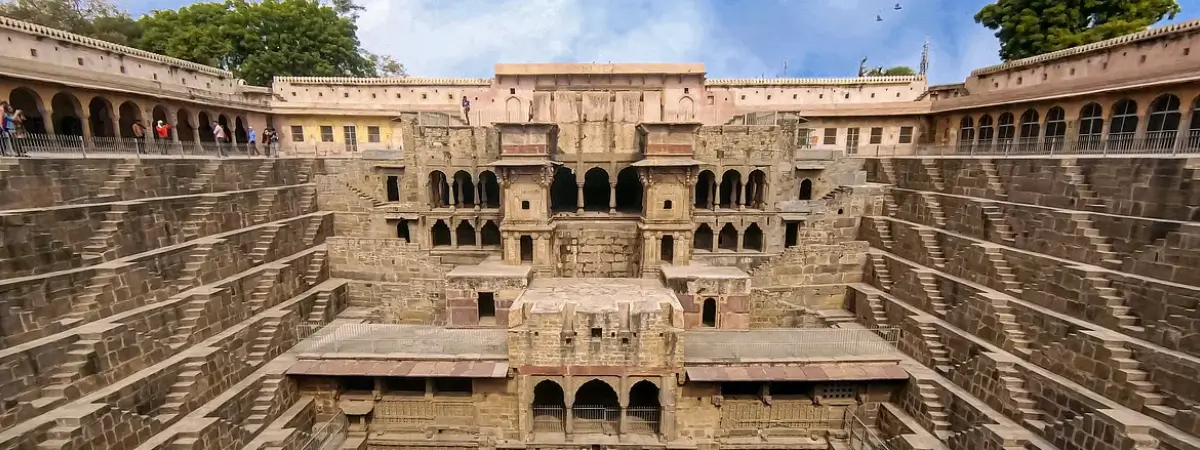
Water shaped the history of north India as much as any emperor did, and nowhere is that clearer than in its stepwells. Carved deep into the earth, these stone staircases once led townspeople down to cool water through the dry months, and the finest of them are as elaborate as palaces. Our Golden Triangle Tour with Bundi Stepwells follows that thread from the hidden Agrasen ki Baoli in central Delhi to the dizzying geometric steps of Chand Baori at Abhaneri, then on to Bundi, a small hill town in Rajasthan with more than fifty stepwells and water tanks. The Taj Mahal, Agra Fort and the palaces of Jaipur sit along the way, so the classic sights are all covered.
Bundi itself is a quiet reward at the end of the route. Its blue-washed old town climbs a hillside below the Garh Palace and Taragarh Fort, the bazaars are unhurried and the murals of the Chitrashala are among the finest in Rajasthan. Rudyard Kipling stayed here and wrote part of Kim in the town. Travel throughout is by private car and driver, with local guides in each city, and the return to Delhi is by a comfortable express train from nearby Kota, which saves a long road transfer. This Rajasthan stepwell tour suits travellers who have read about the Golden Triangle and want to add one lesser-visited town where you still see more locals than tourists in the lanes.
Tour Highlights
 Package Includes:
 Package Excludes:
Reply within 24hrs
Your chauffeur greets you just outside the arrivals hall at Indira Gandhi International Airport, holding a sign with your name, and walks you to a private air-conditioned car parked close by. The transfer to your hotel takes forty minutes to an hour, depending on the time of day and the traffic around Dhaula Kuan. Use the ride to settle in, ask any first questions and pick up a local SIM card if you want one, which your driver can help arrange with your passport. Check-in usually begins at 2 pm, though most hotels will try to have the room ready sooner for overnight arrivals.
Nothing is fixed for the rest of the day, so rest and recover from the flight. If you feel like stretching your legs in the evening, the hotel concierge can point you to a nearby market such as Khan Market for coffee and bookshops, or Janpath for handicrafts. Your tour specialist will phone to introduce the week ahead and answer questions about the stepwells, the train journey from Kota and suitable clothing for temple visits. Note that stepwell steps can be steep, narrow and uneven, so comfortable shoes with good grip are worth packing near the top of your bag. Overnight stay in Delhi.
Begin with a surprise in the middle of the modern city. Tucked down a lane off Hailey Road, a short walk from Connaught Place, Agrasen ki Baoli drops 108 steps between high stone walls to a well shaft at the bottom. Pigeons wheel through the arched niches, and the noise of traffic fades as you descend. Your guide explains how stepwells kept communities alive through the long dry season. Then drive south to the Qutub Minar complex, where the 73-metre tower stands beside the Iron Pillar, which has resisted rust for some sixteen centuries thanks to the high phosphorus content of its iron.
Next door, walk through Mehrauli Archaeological Park to Rajon ki Baoli, a sixteenth-century stepwell built by the Lodi dynasty for masons, with arched galleries on three levels and a small mosque beside it. After lunch, drive to Old Delhi for a cycle rickshaw ride through Chandni Chowk, then a visit to Jama Masjid, whose courtyard can hold 25,000 worshippers. If it is not Monday, when the Red Fort stays shut, stop at its Lahori Gate for a look at the long Chhatta Chowk arcade. Return to the hotel in the evening with a clearer sense of how layered the city really is. Overnight stay in Delhi.
A smooth run down the Yamuna Expressway brings you to Agra by late morning. Check in at your hotel and enjoy a relaxed lunch before your guide arrives. Begin at Agra Fort, a crescent-shaped citadel of red sandstone and marble on the west bank of the Yamuna. Inside, look closely at the Khas Mahal, where marble channels once carried water across the floors to cool the royal apartments, and the Jahangiri Mahal with its Hindu-style brackets and balconies. Your guide explains the Mughal fascination with running water, which you will see repeated in every garden and tomb on this tour.
Late in the afternoon, head for the Taj Mahal, entering through the West or East Gate depending on queues. The monument is closed on Fridays, so on a Friday this visit is moved to the following morning before the drive to Jaipur. Walk the length of the central canal, which divides the charbagh garden into four quarters, and on to the riverside terrace behind the tomb, where the Yamuna once supplied water for the gardens through an ingenious system of wells and aqueducts. Watch the marble shift from white to soft gold as the sun goes down. Dinner tonight is at leisure. Overnight stay in Agra.
Leave Agra after breakfast and head west along the Jaipur highway. Roughly three hours in, turn off near Sikandra to the village of Abhaneri, home to Chand Baori, one of the deepest and most spectacular stepwells in India. Built in the ninth century by the Nikumbha rulers, it plunges about thirty metres in thirteen levels, its 3,500 narrow steps arranged in perfect zigzag triangles on three sides. On the fourth side rises a pavilion of galleries and balconies used by the royal family. Visitors are no longer allowed down the steps, but the view from the top railing is the real spectacle.
Across the lane stands the Harshat Mata temple, an eighth-century shrine dedicated to the goddess of joy, with fine sculpted panels of musicians and dancers despite damage over the centuries. Village children often follow visitors around, and a small chai stall near the stepwell makes a pleasant halt before the road. Continue for another ninety minutes or so to Jaipur, arriving in the late afternoon. After checking in, take a gentle evening walk around the old walled city, where the facades along Tripolia Bazaar and Chandpole Bazaar glow a warm pink as the street lights flicker on. Overnight stay in Jaipur.
After breakfast, drive eleven kilometres north to Amber Fort, rising above Maota Lake on a ridge of the Aravalli hills. Walk up through the Suraj Pol or ride a jeep to the main courtyard, then visit the Diwan-i-Aam, the Sheesh Mahal with its mirror mosaics and the Sukh Niwas. Your guide points out the system of wheels and channels that lifted water from the lake to the palace. Just down the road lies Panna Meena ka Kund, a sixteenth-century stepwell whose stairs crisscross in a pattern that seems to shift as you walk around its edge, with the fort and hills reflected in the water.
Return to the city for lunch, then visit the City Palace, still home to the Jaipur royal family, with its museum of textiles, arms and royal costumes. Next door, Jantar Mantar holds nineteen giant astronomical instruments built by Sawai Jai Singh II, including a sundial accurate to about two seconds. Finish with a photo stop at the Hawa Mahal, the five-storey palace of windows built so royal women could watch street processions unseen. In the evening, browse Johari Bazaar for gemstones and silver jewellery, or Bapu Bazaar for embroidered juttis, bandhani scarves and quilted cotton razais. Overnight stay in Jaipur.
Head south through the farmland of central Rajasthan, passing Tonk and small villages where women in red and orange odhnis carry brass water pots. The road is good, and your chauffeur will stop for tea and fresh samosas at a roadside stall. As you near Bundi, the hills close in and the first sight of the town stops most visitors mid-sentence: the walls of Taragarh Fort trace the ridge, and the Garh Palace tumbles down the slope below them. Check in at a heritage haveli hotel in the old town; many of these family-run houses have rooftop terraces facing the palace.
In the afternoon, walk with your guide through the lanes of the old town, where many houses are painted in shades of blue, much like Jodhpur but on a gentler, quieter scale. Stop at the Nagar Sagar Kund, a pair of identical stepwells by the Chogan Gate, and watch local life around the small temples and sweet shops of Sadar Bazaar. As the sun sets, climb to a rooftop cafe and watch the palace light up while bats flit around its towers and the call to prayer mixes with temple bells. Dinner at the haveli features home-style Rajasthani dishes. Overnight stay in Bundi.
Start with Bundi's most celebrated stepwell, Raniji ki Baori, built in 1699 by Rani Nathavati, a queen of Bundi. A grand arched entrance leads down a long, deep flight of steps flanked by carved pillars, brackets in the shape of elephants and niches with images of Hindu deities. The stone keeps the air cool even at midday. Nearby, the Dabhai Kund, also called the Jail Kund, is one of the largest step tanks in Bundi, with a dense geometric web of stairs. Your guide explains how these water structures were often commissioned by royal women as acts of charity and civic pride, and how they doubled as social meeting places.
Later, climb up to the Garh Palace through the Hathi Pol, the elephant gate. Its highlight is the Chitrashala, a small courtyard whose walls are covered in blue and turquoise murals of Krishna, court life and hunting scenes. Above, a steep path leads to Taragarh Fort, overgrown and home to monkeys, with sweeping views over the town and the Nawal Sagar lake. In the late afternoon, visit Sukh Mahal, the summer palace by Jait Sagar lake where Kipling stayed, and the 84-pillared cenotaph, Chaurasi Khambon ki Chhatri, built in 1683 by Rao Raja Anirudh Singh in memory of his foster brother Deva. Overnight stay in Bundi.
After breakfast, check out and drive forty kilometres to Kota Junction, a major railway station on the Delhi–Mumbai line. Your chauffeur helps carry the luggage to the platform, and a porter can be arranged for heavier bags. Board the express train to Delhi, usually the Rajdhani or a similar fast service, in an air-conditioned chair car or sleeper class depending on timing. The journey takes around five to six hours, with a meal and tea often served on board. Watching village India roll past the window, with its mustard fields, buffalo ponds and level crossings, is a relaxing way to spend the final day.
At Hazrat Nizamuddin or New Delhi railway station, a chauffeur waits on the platform with a name board and transfers you to Indira Gandhi International Airport for your flight home. If your departure is the following day, your specialist can book a hotel near the airport for an extra night at additional cost. During the drive, take a few minutes to look back over the many stepwells you have seen, from the hidden staircase off Connaught Place to the blue lanes of Bundi. Our team stays in touch by phone until you are safely on your flight, and we wish you a smooth trip home.
Hear what our happy guests say about their India adventures! From private drivers to guided tours, we make every journey smooth, safe & unforgettable.
 rating score: 5.0 of 5, based on 448 reviews

Complete our inquiry form

Customize your itinerary

Confirm when you're satisfied
1-to-1 Service | Reply within 24hrs | Expert's Advice