Delhi - Jaipur - Samode - Pachewar - Pushkar - Rohet - Jojawar - Deogarh - Udaipur
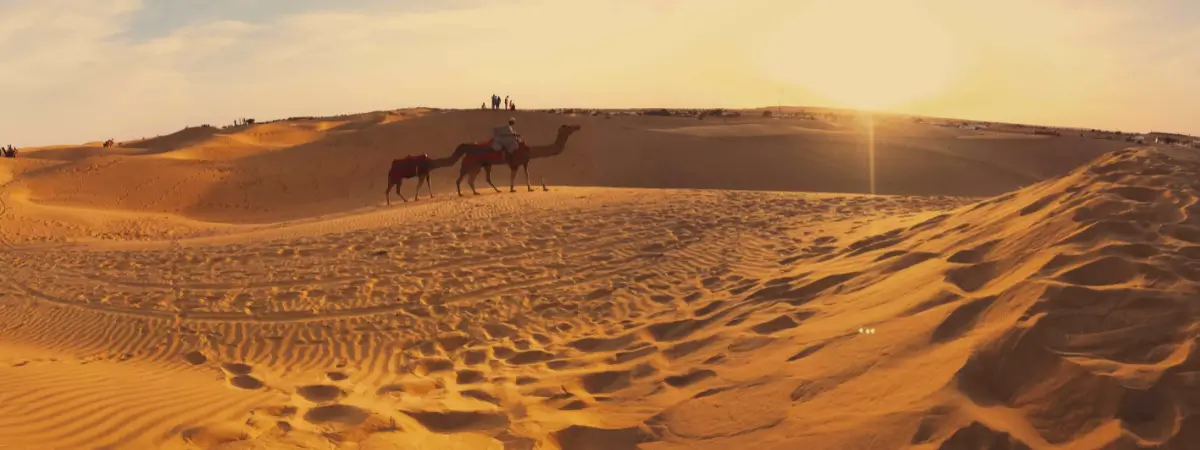
Real Rajasthan lives in its villages, where roughly three out of four people in the state still make a living from fields, herds and handwork, and the Rajasthan Rural Village and Local Culture Tour is written for travellers who want to meet them. Over twenty days you sit with Bishnoi families who guard every blackbuck on their land, watch Raika herders water camels at a stone trough, learn how block printers in Bagru carve and stamp their patterns, and share a kitchen with a farming household outside Deogarh. Monuments are not ignored, since Delhi, Jaipur and Udaipur all have palaces and forts you will be glad you saw, but they share the stage with weekly markets, potters' yards, henna farms and temple fairs. Nights are spent in small village forts and family estates, where your hosts know everyone for miles around and can open doors no guidebook mentions.
The route runs in an easy arc from Delhi through Jaipur into the farm country of Samode and Pachewar, then west to the holy lake at Pushkar and on into the Marwar villages around Rohet and Jojawar before crossing the Aravallis to Deogarh and Udaipur. Drives are rarely longer than four hours, and every transfer includes a stop worth making, whether a terracotta village, a roadside stepwell or a dhaba famous for its mirchi vada. You travel throughout in a private car and driver arrangement, and an English-speaking local guide or host accompanies each village visit so that conversation flows both ways and photographs are taken with permission. This Rajasthan village tour suits curious travellers of any age who are comfortable with simple country roads and happy to sit on a charpai with a glass of sweet tea and simply listen.
Tour Highlights
 Package Includes:
 Package Excludes:
Reply within 24hrs
Touching down at Indira Gandhi International Airport, you are met outside the arrivals hall by our representative, who carries a name board and a small welcome pack containing a local SIM card on request, a map of the route and the phone numbers you will need over the next three weeks. Your chauffeur, who will stay with you for much of the trip, loads the luggage into an air-conditioned car and drives you to a quiet hotel in central Delhi. Most long-haul flights land late, so the rest of the day belongs to you, and the hotel will have your room ready for an early night after the journey.
Should you arrive by afternoon, a gentle way to meet the city is a walk around Dilli Haat at INA, an open-air craft bazaar where artisans from every Indian state take turns selling their own work from small stalls. It is a useful first look at the textiles, pottery and metalwork you will later see being made in Rajasthan's villages, and the food court serves dishes from the north-east, Kashmir and Bengal side by side. Your guide or chauffeur can explain how the stall rotation works so that you can come back later if you wish. Head back before dark, when the traffic eases, and rest well for the walking ahead tomorrow.
Overnight stay in Delhi.
Today's Delhi city tour puts people before monuments. Your local guide meets you at the hotel and you ride the metro to Chawri Bazar, a cheap and efficient ride that shows how the city commutes. From there you walk up to Jama Masjid, the great congregational mosque completed in 1656, and climb the southern minaret, if open, for a view over the rooftops. Then plunge into the lanes: paper merchants and wedding-card printers in Chawri Bazar, silver dealers in Dariba Kalan, and Khari Baoli, Asia's largest wholesale spice market, where porters haul sacks of chillies and turmeric and a narrow staircase leads to a rooftop overlooking the trading courtyard.
Late morning you reach Gurudwara Sis Ganj Sahib on Chandni Chowk, where volunteers cook and serve free meals to anyone who walks in. Cover your head, leave your shoes at the counter and sit cross-legged to share langar with families, students and day labourers, then see the kitchen where rotis are turned out by the thousand. The car collects you for an afternoon drive past India Gate and the government buildings of Lutyens' Delhi, ending at Raj Ghat, the simple memorial where Mahatma Gandhi was cremated. Note that the Red Fort, which faces Chandni Chowk, is closed on Mondays, so we view it from outside if your date falls then.
Overnight stay in Delhi.
Set off after an early breakfast on the highway to Jaipur. Your chauffeur knows which stretches are fastest at which hour and will suggest a mid-morning break at a highway restaurant near Neemrana, where a fifteenth-century hill fort stands just off the road. The drive itself is a lesson in rural North India: tractor trolleys loaded with sugarcane, camel carts on the service lanes in winter, roadside brick kilns with tall chimneys and small truck-stop shrines decorated with marigolds. Ask your chauffeur to point out the mustard fields if you travel between December and February, when whole districts turn bright yellow.
Arriving in Jaipur by early afternoon, check in at a family-owned guesthouse or small heritage hotel run by a local household. In the evening, a short walk through Bapu Bazaar and Nehru Bazaar inside the walled city introduces the everyday shopping of Jaipur families: leather mojari shoes, block-printed bedspreads, lac bangles and spices sold by weight. Before dinner, stop at a lassi shop on Mirza Ismail Road, where the yogurt drink is served thick in a clay cup and topped with cream. Your guide for tomorrow will call to confirm timings, as the day begins early so that you reach the artisan villages while work is in full swing.
Overnight stay in Jaipur.
Leave the city behind this morning for Bagru, a village about thirty kilometres south-west of Jaipur where Chhipa families have printed cloth by hand for some four hundred years. At a family workshop you see the whole process: cloth soaked and beaten in the river, dyes made from pomegranate rind, indigo and iron rust, and hand-carved teak blocks pressed down in rhythm along long tables. Then you try printing a scarf yourself under the eye of a master printer, a messy and enjoyable hour. Bagru's distinctive dabu technique, using a mud resist before dyeing, is explained step by step, and the scarf you print is yours to keep.
On the way back, call in at Sanganer, a town on Jaipur's southern edge famous for handmade paper and its own lighter style of block printing. At a paper workshop, cotton rags are pulped, spread on frames and dried in the sun to become notebooks and wrapping paper. Then visit a blue pottery studio, where quartz-based clay, rather than ordinary earth, is shaped and painted with cobalt and copper designs that trace back to Persian ceramics. Return to Jaipur by mid-afternoon to rest. In the evening, take a cycle-rickshaw ride along the walled city lanes as shopkeepers light their lamps and the temple bells begin to ring.
Overnight stay in Jaipur.
Morning brings Jaipur's great fortress at Amber, visited early with a local guide before the courtyards fill. Rather than repeating the main tour of halls, ask your guide to walk you down afterwards through Amber town itself, the old capital that still lives below the fort, with its stepwells, small temples and workshops making carved marble images. Here, in a restored haveli, the Anokhi Museum of Hand Printing displays centuries of printed textiles and has a block carver at work on site, a fine follow-up to yesterday in Bagru. The museum is closed on Mondays and for part of the summer, so we adjust the order if needed.
In the late afternoon you visit the home of a Jaipur family for a cooking class in their own kitchen. The lady of the house shows you how to make dal baati churma, the baked wheat balls served with lentils and a crushed sweet, along with gatte ki sabzi, gram-flour dumplings in a yogurt curry, and a simple chutney of garlic and red chilli. Conversation flows easily over the stove, from wedding customs to school exams and the price of vegetables, and the evening ends around the family dining table eating what you have cooked together. The recipes are shared so that you can cook them at home.
Overnight stay in Jaipur.
A short drive north-west takes you out of the city and into the Aravalli foothills to Samode, a village of a few thousand people that grew up below its palace. The road passes through Chomu, a busy market town, before narrowing into a lane lined with fields of millet and wheat. Samode Palace, now a heritage hotel, rises against the hills at the top of the village, and its painted halls are worth seeing, but the real interest here is the village itself, where most families farm or work in crafts. Check in by late morning and take lunch on the palace terrace overlooking the rooftops below.
After a rest, walk with a local guide into the lanes of Samode. The village is known for its lac bangle makers, families who heat sticks of resin over charcoal stoves, colour them with pigments, and roll and press them into bangles studded with glass and beads. Sit with one of the families and watch the bangles take shape in minutes, or have one made to fit your wrist. The walk continues past the village stepwell, a cattle pond where women gather in the evening, and small temples to Hanuman and Gopal. Return to the palace for a sundowner as cowbells sound from the lanes below.
Overnight stay in Samode.
Begin with a dawn walk up the stone steps to the small hill fort above the palace, a climb of about thirty minutes rewarded by views across the village and the rolling Aravalli hills. On the way down, stop at the village primary school gate if term is running, where children practise their English greetings, and at the dairy collection point, where farmers bring morning milk in steel cans to be tested and weighed. After breakfast, a jeep takes you a few kilometres to Samode Bagh, a Mughal-style garden with fountains, water channels and old trees, once the royal family's retreat and now a calm place to sit with a book.
The afternoon is for village crafts and food. A local guide takes you to a family that weaves dhurries, the flat cotton rugs used across rural Rajasthan, on a simple pit loom set into the floor of their home. Next door, a carpenter carves small wooden toys and window frames by hand. Before sunset, the palace can arrange a camel-cart ride along the field tracks, passing farmers bringing their animals home and boys playing cricket on the threshing grounds. Dinner tonight is a simple Rajasthani meal featuring ker sangri, a dish of desert beans and berries, and bajra roti made from millet flour.
Overnight stay in Samode.
Leave Samode after breakfast and skirt Jaipur to the south, heading into Tonk district, a quiet farming region where few foreign visitors travel. The landscape opens out into wide fields of wheat, mustard and gram, with neem trees around every village well and herds of goats drifting along the verges. Your destination is Pachewar, a small village built around an eighteenth-century fort that is still owned by the family whose ancestors built it, and which now opens a handful of its rooms to guests. The fort stands on the edge of a large lake, and its stout walls and corner towers dominate the village.
Arrive in time for lunch in the fort courtyard, followed by a rest in the heat of the afternoon. Later, walk through the village with a member of the household, who will introduce you to neighbours. You will see women drying cow-dung cakes for fuel, men repairing charpai beds by weaving rope across their frames, and the potter's wheel spinning outside his house. The village shop sells everything from biscuits to tractor parts, and the local temple priest may invite you in for the evening aarti, a short prayer with lamps and bells. Climb the fort ramparts to watch the sun set across the fields and the lake.
Overnight stay in Pachewar.
Today is about the farming year. After breakfast, a bullock cart carries you out of the village along dusty tracks to the fields, where your host explains how families decide what to sow between the rabi winter crop and the kharif monsoon crop, and how the arrival of electric pumps transformed the old wells. Depending on the season, you may see wheat being harvested by sickle, gram drying in the sun or mustard being threshed. At a farmhouse you are offered buttermilk or tea, and the family shows you their cattle shed, the clay storage bins for grain and the outdoor hearth where bajra roti is cooked over a slow fire.
Return to the fort for lunch and a quiet afternoon. In the early evening, walk along the bank of the lake, which fills after the monsoon and draws waterbirds through the winter, including painted storks, spoonbills, grey herons and sometimes flamingos. The local fishermen cast their nets from small boats, and buffaloes wade in to cool off. Your hosts may arrange tea on the bund, the earthen embankment that holds back the water, with a view of the fort reflected in the lake as the light fades. Dinner in the courtyard is lit by lanterns, with village musicians sometimes playing on request.
Overnight stay in Pachewar.
The drive west to Pushkar passes through Kishangarh, a town famous for its marble yards and for the delicate miniature paintings of the Kishangarh school, whose Radha with her long almond eyes appears on many Indian postage stamps. Your chauffeur can stop at the vast marble market on the highway, where slabs of every colour are stacked like books, and at the small lake palace of Gundolao if time permits. You then cross the Nag Pahar, the snake mountain that separates Ajmer from Pushkar, and descend into the small town that wraps around its sacred lake, one of the holiest pilgrimage sites in India.
Your stay in Pushkar is a small, family-run hotel on the edge of town, close to the fields of roses grown here for garlands and rose water. After check-in, walk down to the lake with a local guide. There are fifty-two ghats around the water, and pilgrims bathe, offer flowers and have rituals performed by Brahmin priests, who may ask for a donation; your guide will explain the custom politely. Visit the Brahma temple, one of very few temples in the world dedicated to the creator god, with its red spire and silver coins set into the floor. At sunset, join the evening aarti at Varaha Ghat as bells and drums echo across the lake.
Overnight stay in Pushkar.
Rise before dawn for the walk or ropeway ride up to the Savitri temple on the hill above Pushkar, dedicated to Brahma's first wife, and watch the sun come up over the lake and the desert beyond. Return to town for breakfast at a small café, then drive out to a rose farm, where the pink Damask roses are picked early in the morning between February and April and again after the monsoon. The farmer explains how the petals are sold at temples, dried for gulkand, a sweet rose preserve, or distilled in copper pots into rose water and attar. Sample a spoonful of gulkand straight from the jar.
In the afternoon, head out to the dunes on the edge of town, where camel-herding families from the Raika and Rebari communities keep their animals between fairs. Pushkar's famous camel fair takes place over about a week around the full moon of the Hindu month of Kartik, usually in November; if your dates coincide, this day will be spent at the fairground. At other times, you visit a herding family's camp and see how the camels are cared for, decorated and traded. Return through the main bazaar, where shops sell silver, embroidered bags and Rajasthani puppets, and try malpua, a syrupy pancake sold fresh from the pan.
Overnight stay in Pushkar.
Today you travel west into Marwar, the old kingdom of Jodhpur, along roads that grow sandier and more open with every hour. Fields give way to scrubland dotted with khejri trees, whose leaves feed goats and whose pods go into the ker sangri you tasted in Samode. Stop at a roadside dhaba near Beawar or Bar for tea and a plate of hot mirchi vada, a large green chilli stuffed with spiced potato and fried in batter. The chauffeur will slow down as you pass women in brightly coloured odhnis carrying water pots and herds of camels moving along the side of the road.
Rohet Garh, your base for the next three nights, is a sixteenth-century fort that now runs as a family heritage hotel, set on the edge of a lake about forty kilometres south of Jodhpur. Writers Bruce Chatwin and William Dalrymple both stayed and wrote here, and the rooms carry that slightly literary mood. After lunch and a swim in the courtyard pool, take an evening walk around the lake, where migratory birds arrive in winter and village women come to fetch water. The family's own horses, of the Marwari breed, are stabled within the fort walls, and a short ride along the lakeshore is easily arranged.
Overnight stay in Rohet.
The heart of today is a jeep safari through the villages of the Bishnoi community, followers of a fifteenth-century teacher, Guru Jambheshwar, whose twenty-nine principles forbid cutting green trees or harming animals. Driving through their farms, you see blackbuck, chinkara gazelle and nilgai grazing calmly beside the houses, protected by families who would risk their lives for them. At one homestead, the elders demonstrate the traditional welcome ritual involving opium dissolved in water and strained through cloth, a ceremony that is part of Marwari hospitality; guests watch rather than take part. Women show their round mud-plastered huts with thatched roofs and spotless courtyards.
The safari continues to Salawas, a village of dhurrie weavers, where families work at horizontal looms making flat-woven rugs in cotton, wool and camel hair, and to a potter who throws large water jars on a stone wheel turned by hand. Nearby, a Bishnoi shoemaker makes leather jutis, decorated slippers stitched with coloured thread. Return to the fort for lunch and an afternoon at leisure. In the evening, your hosts may organise a sundowner in the dunes or a performance by Langa musicians, who play the sarangi and kamaicha and sing ballads of local heroes and lovers.
Overnight stay in Rohet.
After an early breakfast, drive about forty-five minutes north to Jodhpur for a day in the blue city. With a local guide you visit Mehrangarh Fort, high on a sandstone cliff, where the museum galleries hold palanquins, howdahs, turbans and miniature paintings, and the rooms of Phool Mahal and Sheesh Mahal display the court's wealth. Look for the handprints of royal widows on the wall beside the Loha Pol gate. Then walk down through the lanes of Brahmpuri, the old Brahmin quarter, where houses are painted blue, and stop at the stepwell of Toorji ka Jhalra, restored and once again full of water.
Lunch at a small restaurant near the clock tower, then walk through Sardar Market, where farmers and craftsmen from the countryside come to sell spices, dried chillies, bandhani tie-dye fabric and copper pots. Your guide can take you to a tie-dye workshop, where women knot thousands of tiny points in cloth before dyeing it, and to a sweet shop for mawa kachori, a pastry filled with condensed milk and nuts. In the late afternoon, if energy allows, visit Jaswant Thada, the white marble cenotaph of the Jodhpur royal family, before returning to Rohet in time for dinner.
Overnight stay in Rohet.
This morning you leave the desert edge and drive south-east towards the Aravalli hills, stopping at Sojat City, known throughout India as the home of the finest henna. Around ninety percent of India's henna is said to come from the fields around Sojat, and a visit to a farm or processing unit shows how the leaves are harvested, dried in the sun, ground in mills and packed into sacks. A local woman may draw a small mehndi design on your hand, and the scent of the fresh paste will stay with you through the day. In the town, old havelis line the market lanes, and a hilltop temple to Chamunda Mata overlooks the fields.
Continue to Jojawar, a quiet valley where a manor house built by a Rathore family offers rooms around a central courtyard. Lunch is home-cooked Marwari food, with laal maas for meat-eaters and plenty of vegetarian dishes. In the evening, walk with a local guide into the village, where Raika herders, a community traditionally dedicated to raising camels, gather with their animals around a stone water trough. Their men wear red turbans and white dhotis, and they talk proudly about each camel's name, ancestry and character. Your guide translates, and you will be offered warm camel milk tea if the herders have just finished milking.
Overnight stay in Jojawar.
A morning drive in an open jeep takes you to the seasonal camp of a Raika family on the edge of the hills, where the herd has been grazing for several weeks. The women have built simple shelters of thorn branches and cloth, and they cook on small fires with dung cakes as fuel. Your host explains how these families move their flocks along traditional migration routes between the Aravallis and the plains, and how the shrinking of common grazing land has made life harder for herders across Rajasthan. You may be invited to help with milking or to watch the young camels being trained.
Afterwards, visit a village where the children learn in a small government school, with permission arranged by your host; it is a good chance to see how rural education works and ask questions of the teachers. After lunch at the manor, set out on a guided walk into the low hills behind Jojawar, following goat trails past rock outcrops, old shrines and a small seasonal lake. Look for peacocks, partridges and, with luck, the shy Indian desert fox. The walk takes two to three hours and is of easy to moderate difficulty. Back at the manor, relax with a cup of masala tea on the terrace as the evening breeze cools the valley.
Overnight stay in Jojawar.
A short and scenic transfer today takes you over the Aravallis into Mewar, the old kingdom of Udaipur. Along the way, stop at a roadside settlement of Gadolia Lohars, the wandering blacksmiths who live in bullock carts and make iron tools, cooking pans and agricultural implements by hand. Tradition holds that their ancestors vowed never to settle under a roof again after the fall of Chittorgarh, and many families still travel from village to village. Watch them work the bellows and hammer out a sickle or a tava, the flat iron griddle used to make roti, and buy one to take home if you like.
Arrive in Deogarh in time for lunch at a heritage stay in this small market town, where your hosts are well connected with the farming villages around. In the afternoon, a guide takes you through the town's bazaar, where traders sell everything from bridal jewellery to cattle bells and copper water pots, and where tailors work on treadle sewing machines in open shop-fronts. Visit a family that dyes and prints turban cloth, and learn how the colour and style of a turban can reveal a man's community, region and occasion. As evening falls, the town's main street fills with shoppers, and the call of street vendors mingles with temple bells.
Overnight stay in Deogarh.
Today is spent in the farming villages outside Deogarh. After breakfast, drive to a family farm where the household grows maize, wheat, barley and seasonal vegetables, and keeps cows, buffaloes and a few goats. Walk the fields with the farmer and see the irrigation channels, the threshing floor and the stacked fodder. Then join the women of the house in their kitchen as they prepare a midday meal on a clay chulha: makki ki roti, flatbread made from maize flour, sarson ka saag in the cooler months, buttermilk, fresh white butter and a pickle of mango or lime. Sit together on mats in the courtyard to eat, with the children watching shyly from the doorway.
If your visit falls on the day of the weekly haat, the rural market held in a nearby village, spend the afternoon there. Farmers, potters, spice sellers and cloth merchants spread their goods on the ground, and villagers come from miles around to buy household supplies, sell produce and catch up on news. It is one of the best places in Rajasthan to see rural trade in action. On other days, visit a local cattle fair or a stone-carving workshop where artisans shape temple images from local marble. Return to Deogarh for a relaxed evening and a farewell dinner with your hosts, who will want to hear about your journey so far.
Overnight stay in Deogarh.
Drive south after breakfast towards Udaipur, stopping at Molela, a village of potters about forty-five kilometres north of the city. For centuries the potters of Molela have made terracotta votive plaques depicting folk gods such as Devnarayan, Dharmraj and the mother goddesses, which tribal communities buy and install in village shrines. A family will show you how the local clay is mixed with donkey dung and rice husk, rolled out, and modelled by hand into figures before firing in an open kiln. Today many also make decorative plaques for homes and hotels, and buying directly from the workshop supports the families.
Continue past Nathdwara, the busy pilgrim town famous for its temple to Shrinathji and its pichhwai paintings, and arrive in Udaipur by mid-afternoon. Check in at a lakeside heritage hotel near Lake Pichola. In the evening, take a walk with a local guide through the old city to Jagdish temple, the seventeenth-century Vishnu shrine with carved elephants at its base, and then along the ghats where women wash clothes and children swim. For this Udaipur city tour evening, finish at Ambrai Ghat, where the view of the City Palace across the water at dusk is one of the finest in Rajasthan.
Overnight stay in Udaipur.
Rise early for a final walk through the old city lanes as Udaipur wakes up. Milkmen deliver on motorbikes, women draw rangoli patterns at their doorways and the smell of fresh jalebi and poha drifts from small breakfast stalls near the Clock Tower. If time allows, visit the City Palace when it opens at nine, or the Bharatiya Lok Kala Mandal folk museum, which displays puppets, masks and costumes from the very villages and communities you have met over the past three weeks. Return to the hotel to pack and check out, with a last look at the lake from the terrace.
Your chauffeur then drives you to Maharana Pratap Airport at Dabok, about forty minutes from the city, for your domestic flight to Delhi, which takes around an hour and a quarter. In Delhi, our representative meets you and transfers you to the international terminal for your onward flight home. Over twenty days you have travelled from Delhi's spice markets to henna farms and herders' camps, sharing meals and conversations with families whose way of life few visitors ever see. We hope the warmth of the people of rural Rajasthan, and the skills they shared with you, travel home with you and stay for a long time.
Hear what our happy guests say about their India adventures! From private drivers to guided tours, we make every journey smooth, safe & unforgettable.
 rating score: 5.0 of 5, based on 448 reviews

Complete our inquiry form

Customize your itinerary

Confirm when you're satisfied
1-to-1 Service | Reply within 24hrs | Expert's Advice