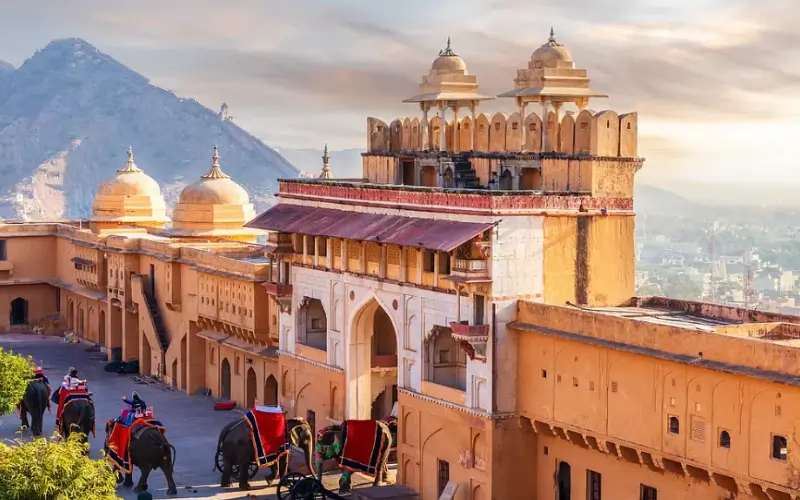
It is a little before 9 PM inside the Meenakshi Temple in Madurai. The great halls are lit by oil lamps and electric bulbs, drums and long brass horns fill the corridors with sound, and a procession of priests carries a silver palanquin through the crowd. Inside it sits an image of Lord Shiva, being taken for the night to the chamber of his consort, the goddess Meenakshi. Hundreds of worshippers press forward, children ride on their fathers' shoulders, and the smell of jasmine and camphor hangs in the warm air. For a visitor from abroad, it is one of the most extraordinary living rituals anywhere in the world.
Tamil Nadu holds the greatest concentration of ancient temples in India, many still in daily worship after more than a thousand years. A Chennai to Madurai temple tour by car links the finest of them in a single route: the rock-cut shrines of Mahabalipuram, the French streets of Pondicherry, the Chola masterpieces of Tanjore, the vast temple city of Srirangam and the towering halls of Madurai. This guide covers the route, distances and fares, what to see at each stop, temple timings and the dress and etiquette rules that every visitor should know.
The classic route runs south along the coast from Chennai to Mahabalipuram and Pondicherry, then turns inland through Chidambaram and Kumbakonam to Tanjore and Trichy, and finally south to Madurai, often with a stop in the Chettinad region. The full route covers about 650 to 750 kilometres and fits comfortably into eight to ten days.
|
Leg |
Distance |
Driving Time |
|---|---|---|
|
Chennai to Mahabalipuram |
58 km |
1.5 hours |
|
Mahabalipuram to Pondicherry |
100 km |
2.5 hours |
|
Pondicherry to Chidambaram |
70 km |
1.5 hours |
|
Chidambaram to Kumbakonam |
75 km |
2 hours |
|
Kumbakonam to Tanjore |
40 km |
1 hour |
|
Tanjore to Trichy |
60 km |
1.5 hours |
|
Trichy to Karaikudi (Chettinad) |
95 km |
2 hours |
|
Karaikudi to Madurai |
90 km |
2 hours |
Roads in Tamil Nadu are generally excellent, with smooth highways along the coast and between the major towns. The East Coast Road from Chennai to Pondicherry is especially scenic, running past fishing villages, casuarina groves and glimpses of the Bay of Bengal.
Car rates in Tamil Nadu follow the usual structure, with a per kilometre rate and a daily minimum of 250 kilometres, plus a driver allowance. The table below shows higher-side Chennai to Madurai car fares for a one-way tour, including the cost of the car returning to Chennai, driver allowance, tolls and parking.
|
Tour Length |
Sedan (INR) |
Innova Crysta (INR) |
Tempo Traveller (INR) |
|---|---|---|---|
|
Direct one-way drop, Chennai to Madurai (1 day) |
9,500 – 12,000 |
13,000 – 16,000 |
19,000 – 24,000 |
|
8-day temple tour, Chennai to Madurai |
40,000 – 46,000 |
52,000 – 60,000 |
72,000 – 84,000 |
|
10-day temple tour, Chennai to Madurai |
48,000 – 55,000 |
63,000 – 72,000 |
88,000 – 100,000 |
The direct drive from Chennai to Madurai covers about 460 kilometres and takes eight to nine hours. It is rarely the best choice for visitors, as the finest temples lie off the main highway.
Rates in Tamil Nadu are often slightly higher than in North India for Innovas and Tempo Travellers, while sedans are similar. The per kilometre rate for a sedan is about INR 14 to INR 17, and for an Innova INR 20 to INR 24, with a driver allowance of INR 400 to INR 600 per night. Tolls on the main highways are moderate, at INR 150 to INR 350 per day for a car.
A car registered in Tamil Nadu avoids interstate permit costs, so it is best to book a local car and driver rather than bringing one from another state. If your tour continues from Madurai to Kerala, the car will need a Kerala permit, which adds about INR 1,500 to INR 3,000 for a sedan.
Most travellers fly into Chennai and fly out of Madurai, which has direct flights to Chennai, Bengaluru, Mumbai and Delhi. Domestic flights from Madurai cost INR 4,500 to INR 9,000 per person depending on the route and season.
The best time for this tour is from November to February, when temperatures are around 25 to 30°C. The northeast monsoon brings heavy rain to the coast from mid-October to early December, and from April to June, the heat inland often exceeds 38°C. January also brings the Pongal harvest festival, when villages decorate their homes with coloured rice-flour patterns and cattle are bathed and painted, which adds a lovely seasonal touch to the tour.
The first stop, Mahabalipuram, sits on the coast just 58 kilometres south of Chennai. It was the great port of the Pallava kings between the 7th and 9th centuries, and its rock-cut monuments are a UNESCO World Heritage Site.
The Shore Temple, standing on the edge of the sea, is one of the oldest structural stone temples in South India. Its twin towers, weathered by centuries of salt wind, look beautiful at sunrise. Nearby, the Five Rathas are a group of monolithic temples, each carved from a single block of granite in the shape of a temple chariot, alongside life-size stone elephants and a lion. Arjuna's Penance, a giant open-air rock relief carved across two enormous boulders, shows gods, animals, sages and the descent of the river Ganges in remarkable detail.
The Shore Temple and Five Rathas open from 6 AM to 6 PM. A single ASI ticket for foreign visitors, about INR 600, covers both sites on the same day. Arjuna's Penance and the nearby cave temples are free. Allow half a day to see the main monuments, ideally in the early morning or late afternoon, when the light is soft and the stone stays cool.
Mahabalipuram is also known for its stone carvers. Workshops line the streets, and visitors can watch craftsmen shaping granite into statues using hammers and chisels, much as their ancestors did. Small carvings make excellent gifts, costing INR 500 to INR 5,000, while larger pieces can be shipped home.
From Mahabalipuram, the East Coast Road continues south for 100 kilometres to Pondicherry, now officially called Puducherry. A French colony until the mid-20th century, its old French Quarter has mustard-yellow villas with bougainvillea spilling over their walls, quiet tree-lined streets, French street names and a seafront promenade that fills with walkers in the early morning and evening.
Pondicherry is a pleasant break from temple visits. Spend a day walking the French Quarter, visiting the Sri Aurobindo community and its peaceful courtyard, and eating in cafés that serve French bakery items, Tamil seafood and fusion dishes. A good dinner for two costs INR 1,500 to INR 3,500. Just outside town, Auroville, an international township founded on ideals of human unity, is known for its golden globe-shaped meditation hall. The visitor centre is open daily, and passes to view the hall from the viewing point are free, though the inner chamber requires advance booking and a specific visit time.
Many travellers spend two nights in Pondicherry, enjoying boutique heritage hotels in restored French and Tamil houses, which cost INR 7,000 to INR 18,000 per night in peak season.
From Pondicherry, the route heads inland across the fertile Kaveri delta, the heartland of the Chola dynasty, which ruled much of South India from the 9th to the 13th centuries.
The first stop is Chidambaram, home to the Nataraja Temple, dedicated to Shiva as the cosmic dancer. Its golden-roofed inner hall and vast corridors make it one of the most important temples in Tamil Nadu. The temple opens from about 6 AM to 12 PM and from 5 PM to 10 PM, with free entry.
Kumbakonam, a temple town with dozens of shrines, lies on the way to Tanjore. Nearby, the Airavatesvara Temple at Darasuram, a UNESCO World Heritage Site, is a masterpiece of Chola sculpture, with tiny carvings so fine that guides use torches to show them. It is usually quiet, with free entry, and opens from about 6 AM to 8 PM.
Tanjore, officially Thanjavur, is home to the Brihadeeswarar Temple, also known as the Big Temple. Built by the Chola king Rajaraja I in the early 11th century, it is a UNESCO World Heritage Site and one of the greatest achievements of Indian architecture. Its tower rises about 66 metres, capped by a granite block estimated to weigh around 80 tonnes. The temple opens from about 6 AM to 12:30 PM and 4 PM to 8:30 PM, with free entry. Visit in the late afternoon, when the granite turns golden in the setting sun. Tanjore is also known for its painted panels with gold leaf and its bronze casting workshops.
From Tanjore, drive 60 kilometres to Trichy, officially Tiruchirappalli. The city is dominated by the Rockfort, a temple complex perched on an 83-metre rock, reached by about 400 steps cut into the stone. The view from the top across the Kaveri River is spectacular. Entry costs a small fee, and cameras may need a separate ticket.
Just outside Trichy, on an island in the Kaveri River, the Sri Ranganathaswamy Temple at Srirangam is one of the largest functioning temple complexes in the world, covering about 156 acres with seven concentric walls and 21 towering gateways. Inside the outer walls is a whole town of houses, shops and markets. A small ticket allows visitors to climb to a rooftop viewing area for views over the temple towers. Non-Hindus may enter most of the complex but not the innermost sanctum.
Before reaching Madurai, many travellers spend a night in the Chettinad region around Karaikudi. The wealthy Chettiar merchant families built grand mansions here in the 19th and early 20th centuries, filled with Burmese teak pillars, Italian marble, Belgian mirrors and hand-made tiles from the nearby village of Athangudi. Several mansions now serve as heritage hotels, costing INR 9,000 to INR 25,000 per night. Chettinad is also famous for its spicy cuisine, one of the finest regional cooking styles in India.
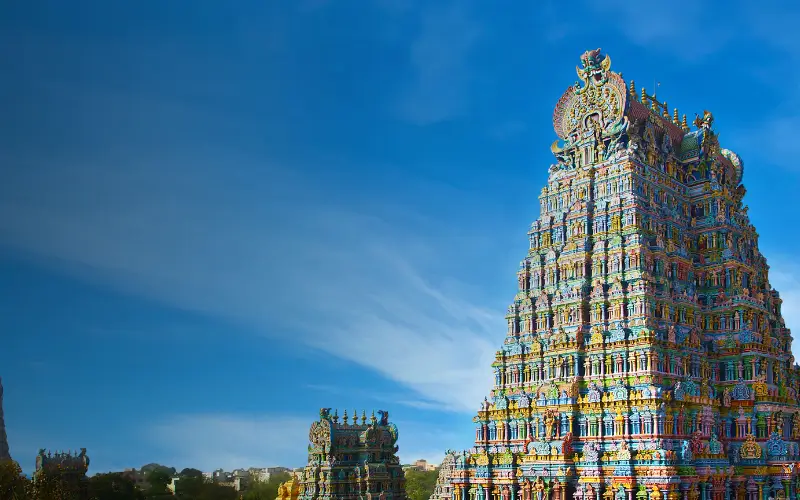
Madurai is the final and most dramatic stop. The Meenakshi Temple stands at the heart of the old city, surrounded by 14 towering gateways covered in thousands of brightly painted sculptures of gods, demons and animals. The tallest, on the southern side, rises about 52 metres. Inside lies a maze of pillared halls, sacred tanks and shrines, with the Hall of a Thousand Pillars housing a small museum of temple art.
The temple opens from about 5 AM to 12:30 PM and from 4 PM to 9:30 PM. Entry is free, though a special entry ticket of INR 50 to INR 100 offers a faster queue for viewing the main shrines. Mobile phones and cameras are not allowed inside, and must be deposited at counters near the entrance for a small fee. Non-Hindus may visit most areas but not the innermost sanctums. The night ceremony, held around 9 PM, when Shiva's image is carried to Meenakshi's chamber, is a memorable sight.
Other sights in Madurai include the Thirumalai Nayak Palace, a 17th-century palace with massive white pillars and an evening light and sound show, and the Gandhi Memorial Museum, which holds the blood-stained garment Gandhi wore at his assassination. The palace ticket for foreign visitors costs about INR 50 to INR 100.
Temple etiquette in Tamil Nadu is stricter than in North India, and visitors are expected to follow a few rules. Dress modestly, covering shoulders and knees. Long trousers or long skirts, along with shirts with sleeves, are appropriate. Some temples have dress codes that do not allow shorts or sleeveless tops at all. Remove shoes before entering the temple compound, and leave them at the shoe counters, which charge a few rupees. In hot weather, the stone floors can be very warm by midday, so visiting in the morning or evening is more comfortable.
Photography is restricted in many temples. It is often allowed in the outer corridors with a camera ticket, but never inside the shrines. Follow signs and the instructions of temple staff. Leather items such as belts and bags may be restricted in some temples.
Be respectful of worshippers. Do not walk in front of people praying, and keep a quiet voice. If offered sacred ash or a sweet offering by a priest, accept it with your right hand. Small donations are welcome but not required.
Heritage India Private Tours arranges South India temple tours with local Tamil Nadu cars, experienced English-speaking drivers and licensed guides in each temple town. Founder Magan Singh and his team have hosted many guests on long South India tours, often combining Tamil Nadu with Kerala.
Eight to ten days allows a comfortable pace with stops in Mahabalipuram, Pondicherry, Tanjore, Trichy, Chettinad and Madurai.
About 460 kilometres directly, or 650 to 750 kilometres via the coastal and temple route.
An eight-day tour costs about INR 40,000 to INR 46,000 in a sedan and INR 52,000 to INR 60,000 in an Innova Crysta, one way.
About 5 AM to 12:30 PM and 4 PM to 9:30 PM. The night ceremony takes place around 9 PM.
Yes, most areas are open to all visitors, but the innermost sanctums of many temples are reserved for Hindus.
No. Phones and cameras must be deposited at counters near the entrance.
Clothing that covers shoulders and knees. Shoes must be removed before entering temple compounds.
About INR 600 for foreign visitors, covering both the Shore Temple and the Five Rathas on the same day.
November to February, when the weather is warm but comfortable and the monsoon rains have eased.
Yes. Munnar and Thekkady are four to five hours from Madurai, making Kerala an easy extension.