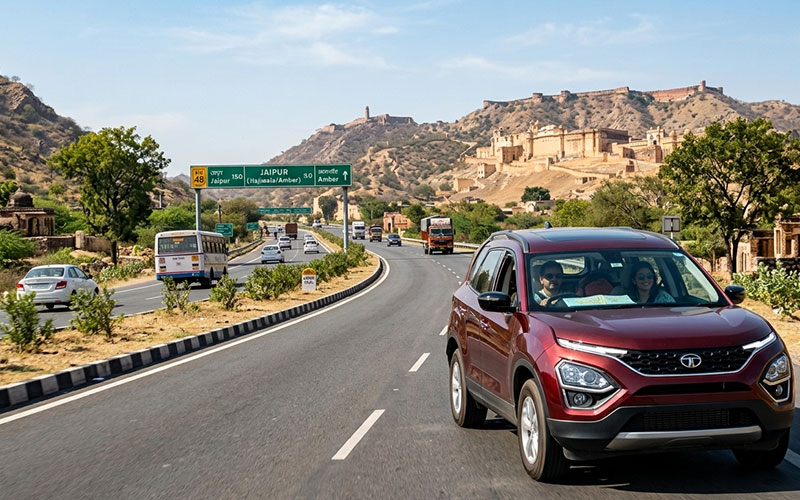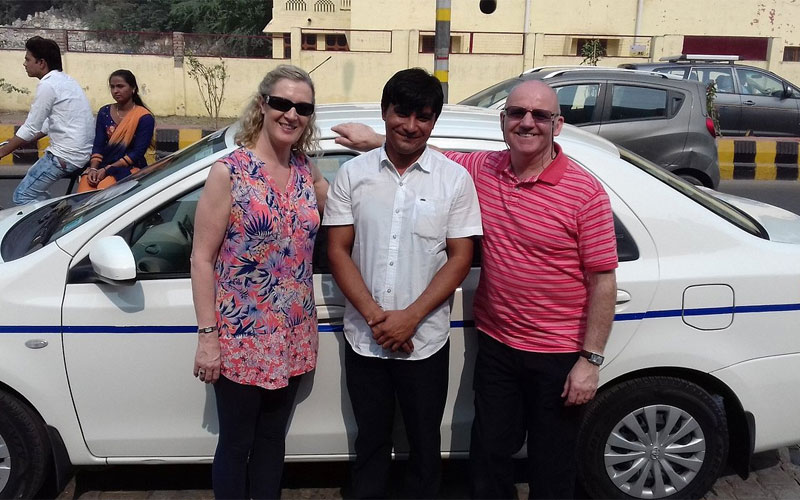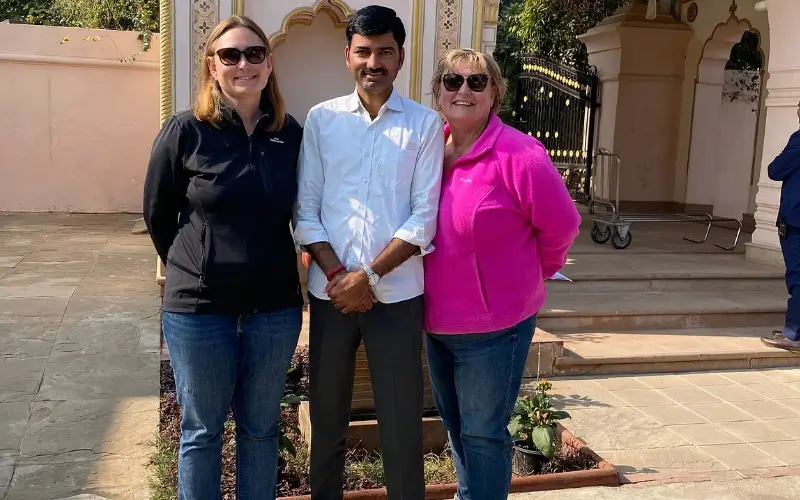
On the eighteenth day of their tour, somewhere between Bundi and Jaipur, Hans and Ingrid from Hamburg realised they had stopped thinking about the car at all. Their driver, Suresh, knew how they liked their coffee, which of them preferred the front seat, and that Ingrid wanted to stop for every herd of camels. He had found them a pharmacy in Jodhpur at 9 PM, waited patiently through a three-hour lunch in Udaipur and steered them away from a carpet shop without a word being said. When the final bill came, it matched the quote to the rupee, with no extra lines for tolls, permits or "night charges."
Hiring a car and driver in India for 2 to 3 weeks is one of the best ways to see the country, but long hires bring their own questions. How are daily rates calculated over three weeks? What does the driver allowance cover? What happens on days when you stay in one place? And which charges tend to appear only at the end? This guide answers each of these, with realistic rates and sample costs for fourteen-day and twenty-one-day tours.
Most companies price long tours using the same structure as shorter trips: a per kilometre rate with a minimum daily distance, usually 250 kilometres, plus a daily driver allowance. The difference on long hires is that small details add up. A rate that looks only INR 2 per kilometre cheaper can save INR 10,000 over three weeks, while a missing toll line can add the same amount back.
Some companies offer a small discount for tours longer than fifteen days, usually 5 to 10 percent off the per kilometre rate, because the car is booked continuously and there are no empty transfers between bookings. Others prefer to offer a fixed package price. Either approach is fine, as long as the total is clear before you travel.
|
Vehicle |
Per Km, Long Hire (INR) |
14 Days, All-Inclusive (INR) |
21 Days, All-Inclusive (INR) |
|---|---|---|---|
|
Sedan (Dzire / Etios) |
13.5 – 15.5 |
60,000 – 70,000 |
88,000 – 102,000 |
|
Maruti Ciaz |
14.5 – 16.5 |
64,000 – 75,000 |
94,000 – 110,000 |
|
Toyota Innova Crysta |
18.5 – 22 |
80,000 – 94,000 |
118,000 – 135,000 |
|
Toyota Innova Hycross |
20 – 24.5 |
87,000 – 102,000 |
128,000 – 148,000 |
|
Tempo Traveller (12 seats) |
25 – 29 |
105,000 – 122,000 |
155,000 – 178,000 |
These totals assume the standard 250 kilometre daily minimum, a driver allowance of INR 450 to INR 600 per night, and tolls, state permits and parking for a typical North India and Rajasthan route. They sit on the higher side, reflecting newer cars and experienced English-speaking drivers.
On long tours, the effective daily rate often falls slightly compared with a one-week trip, because one-way return charges are spread over more days. A fourteen-day sedan tour typically works out to INR 4,300 to INR 5,000 per day all-inclusive, and a twenty-one-day tour to INR 4,200 to INR 4,850 per day.
Choosing the right car matters more on long tours than short ones. Over three weeks, you may spend 60 to 80 hours on the road. The extra legroom and higher seating of an Innova make a real difference to comfort, and its larger boot handles suitcases plus three weeks of shopping. For two travellers on a tour longer than two weeks, the Innova is often the wiser choice, even though it adds about INR 1,000 to INR 1,500 per day.
Ask for a car that is no more than three to four years old, with working rear seat belts, strong air conditioning and clean upholstery. On a three-week tour, small issues such as a weak air conditioner or a broken window become real annoyances, so it is reasonable to ask for a photo of the actual car before you pay the deposit.
Finally, check what happens if the car needs servicing during the tour. Long trips often pass the service interval, and a reliable company arranges servicing on a rest day or provides a replacement car for a few hours without charge.
The driver allowance is a fixed amount paid for each night the driver spends away from home. It covers his meals and small personal expenses. On long tours, the allowance ranges from INR 400 to INR 700 per night, and over three weeks it adds INR 8,000 to INR 14,000 to the total. Most quotes include it, but some list it separately at the end, so check.
Accommodation for the driver is normally provided free by hotels. Most heritage hotels, business hotels and resorts in Rajasthan and the Golden Triangle have driver rooms or dormitories with beds, bathrooms and simple meals. Problems arise at a few small boutique stays, homestays and desert camps without driver facilities. In those cases, the driver finds a guesthouse nearby, and a good company either includes this cost or tells you upfront. Expect INR 500 to INR 1,000 per night where it applies.
Rest days are an important part of long tours. If you stay three nights in Udaipur and want only a short drive on the middle day, the car is still yours for the full day, and the 250 kilometre minimum still applies in most quotes. This is fair, because the driver cannot take other work while he is with you. However, these quieter days give the driver a chance to rest, wash the car, and handle his laundry and phone calls home.
On a twenty-one-day tour, it is good practice to include at least two or three lighter days, with little or no driving. A tired driver is a safety risk, especially on rural roads, and experienced companies build rest into the itinerary.
Daily working hours should be reasonable. A typical day runs 10 to 12 hours, including waiting time, with actual driving kept under eight hours. If you want a very early start for sunrise, followed by an evening outing, try to keep the middle of the day quiet.
Some companies change drivers midway through a three-week tour, especially if the driver needs to return home for family reasons. Ask about this before booking. Most travellers prefer one driver for the whole trip, and a good company will try to arrange that.
Treating your driver well pays back many times over. Ask about his family, offer him water and snacks during long drives, and include him when you stop for tea. Many guests invite their driver to join them for a meal once or twice during the tour, which he will usually appreciate even if he politely declines.
Tipping on long tours is customary and important, as drivers depend on it for a meaningful part of their income. For a fourteen to twenty-one day tour with excellent service, INR 500 to INR 1,000 per day is a fair range, which works out to INR 7,000 to INR 21,000 in total. It is best given as one amount in an envelope on the last day, with a word of thanks.
Most hidden charges are not hidden on purpose. They appear because the quote was built on assumptions that changed during the trip. Knowing them in advance avoids surprises.
Extra kilometres are the most common. If the quote is based on an estimated distance, every extra detour, evening drive or change of route adds to the total. On a three-week tour, an extra 300 to 500 kilometres is common, which adds INR 4,500 to INR 11,000 depending on the car. Ask whether your quote has a fixed price or a distance limit.
State permits multiply on long tours. A car that crosses from Delhi into Uttar Pradesh, Rajasthan, Madhya Pradesh and back may pay several separate permits. For a sedan, each state can cost INR 500 to INR 2,500, and more for larger vehicles. Make sure all the states on your route are included.
Night charges apply when the car runs after 10 PM, usually INR 300 to INR 500 per occasion. Late flight arrivals, evening shows and dinners outside the city can trigger them.
One-way return charges apply if the tour ends far from the car's base, such as finishing in Mumbai or Varanasi when the car is from Jaipur. On long tours this charge can be INR 10,000 to INR 25,000, depending on distance.
Hill charges can apply on mountain routes such as Shimla, Manali or Mount Abu, where some companies add INR 300 to INR 500 per day for the extra strain on the car and driver.
Parking at monuments and cities is usually small, INR 50 to INR 300 per stop, but over three weeks it can reach INR 3,000 to INR 5,000.
Festival days, such as Diwali or Holi, may come with a small festival allowance for the driver, typically INR 500 to INR 1,000, which is a fair gesture as he spends the festival away from home.
Finally, check GST. Car rental with a driver carries 5 percent GST, and some quotes leave it out. On a INR 100,000 tour, that is INR 5,000.
The simplest protection is a written, all-inclusive quote that lists the car model, route, total days, kilometre allowance and every included charge, with clear rates for any extras. Keep a copy on your phone and refer to it if a question comes up during the tour, as most disputes are settled in minutes when both sides can see the same document.
To show how these numbers come together, here are sample car and driver costs for two common long routes. They cover the car and driver only, not hotels, guides or tickets.
The first is a fourteen-day North India and Rajasthan loop: Delhi, Agra, Ranthambore, Jaipur, Pushkar, Udaipur, Jodhpur, Jaisalmer, Bikaner, Mandawa and back to Delhi. It covers about 3,200 to 3,500 kilometres and passes through three states.
The second is a twenty-one-day grand tour: Delhi, Agra, Gwalior, Orchha, Khajuraho, then back west through Ranthambore, Bundi, Udaipur, Kumbhalgarh, Jodhpur, Jaisalmer, Bikaner, Shekhawati and Jaipur to Delhi. It covers about 4,800 to 5,300 kilometres and passes through four states.
|
Route |
Sedan (INR) |
Innova Crysta (INR) |
Tempo Traveller (INR) |
|---|---|---|---|
|
14 days, North India and Rajasthan loop |
62,000 – 72,000 |
82,000 – 96,000 |
108,000 – 125,000 |
|
21 days, Central India and Rajasthan grand tour |
92,000 – 106,000 |
122,000 – 140,000 |
160,000 – 185,000 |
For two travellers, the fourteen-day loop in an Innova costs about INR 41,000 to INR 48,000 per person, roughly USD 465 to USD 545. The twenty-one-day grand tour in an Innova costs about INR 61,000 to INR 70,000 per person, roughly USD 695 to USD 795. For families of four sharing an Innova, the per person cost halves again.
These figures show why a long hire can be excellent value. A private car and driver for three weeks often costs less per person than a single week of car rental with a chauffeur in Europe or North America.
The fourteen-day route has a rhythm worth noting. Its longest drives are Ranthambore to Jaipur at about three and a half hours, Pushkar to Udaipur at about five hours, Jodhpur to Jaisalmer at five hours and Jaisalmer to Bikaner at five and a half hours. Each is followed by at least one night in the same city, so the driver and travellers both have time to recover.
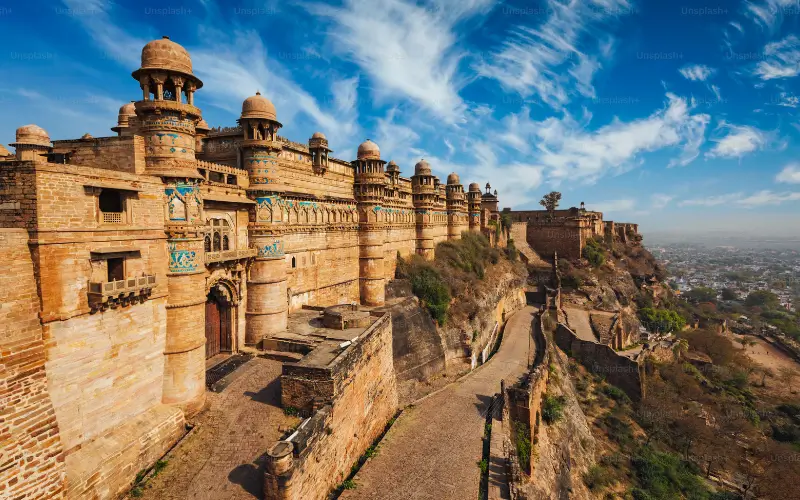
The twenty-one-day grand tour includes Central India's quieter treasures. Gwalior Fort, the riverside palaces and cenotaphs of Orchha and the carved temples of Khajuraho, a UNESCO World Heritage Site, add a different chapter to the familiar Rajasthan story. The road from Khajuraho back towards Ranthambore is long, about eight to nine hours, so many travellers split it with a night in Gwalior or Shivpuri. This adds a day to the car but makes the tour far more comfortable.
Payment for a long hire usually follows a simple pattern. An advance of 20 to 30 percent confirms the car and driver, and the balance is paid during the second week or at the end of the tour, in rupees or by bank transfer. Ask for a receipt for every payment, and settle any extra kilometres or charges on the last day with the written quote in hand.
Heritage India Private Tours specialises in long private tours, with the same experienced driver for the whole trip, newer cars and written all-inclusive quotes that list every charge. Founder Magan Singh has driven guests on tours of up to 35 days across Rajasthan and South India.
A sedan costs about INR 60,000 to INR 70,000 for fourteen days all-inclusive, and an Innova Crysta INR 80,000 to INR 94,000.
A sedan costs about INR 88,000 to INR 102,000 and an Innova Crysta INR 118,000 to INR 135,000 for twenty-one days, including tolls, permits and driver allowance.
Yes. The car and driver stay with you, so the daily minimum usually applies even if you drive very little.
The driver's meals and small personal expenses for each night away from home. It is usually INR 400 to INR 700 per night.
In driver rooms provided by hotels. At a few small properties without them, he uses a nearby guesthouse.
Usually yes, but ask the company to confirm, as some change drivers on very long tours.
Extra kilometres, multiple state permits, night charges, one-way return fees, hill charges and GST.
Some companies offer 5 to 10 percent off the per kilometre rate for tours longer than fifteen days.
About INR 500 to INR 1,000 per day for excellent service, given as one amount at the end.
An Innova Crysta or Innova Hycross offers the best comfort and luggage space for long tours, even for two travellers.